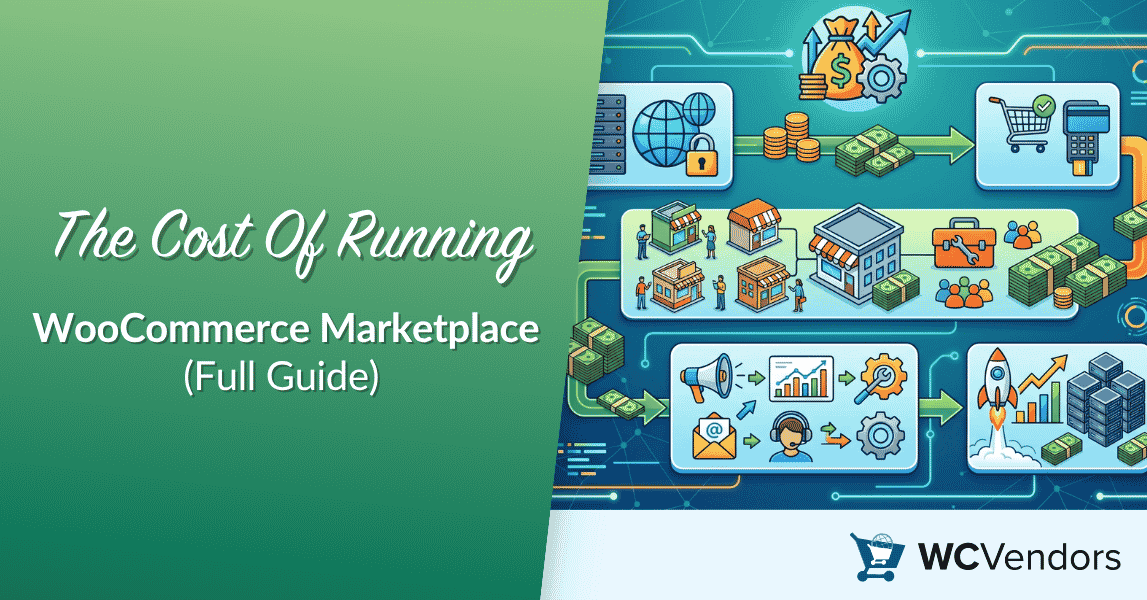
Before I set up my first WooCommerce marketplace, I spent hours trying to figure out what it would actually cost. That vagueness leads to two problems. Some store owners overspend on premium tools before their first vendor even signs up. Others launch unprepared and get hit with costs they did not budget for. Neither situation is ideal when you are trying to build a sustainable marketplace business, which is why getting clarity on the real cost of running WooCommerce marketplace operations matters from day one.
So I built a complete cost breakdown based on real, current pricing data verified against vendor websites. This guide covers every category, compares the total cost of ownership across platforms, and shows you how to launch a WooCommerce marketplace for under $500 in year one (with a path to under $135 if you start lean).
Keeping the cost of running WooCommerce marketplace operations low gives you more budget for the marketing and vendor acquisition that actually capture that opportunity.
Why Most Marketplace Cost Guides Get It Wrong
The cost of running WooCommerce marketplace operations is among the most misreported figures in the WordPress ecosystem. Most guides fall into three traps that distort the real picture.
Total cost of ownership
The first trap is comparing list prices instead of the total cost of ownership. A plugin priced at $69/year looks cheaper than one priced at $149/year until you realize the cheaper one limits you to 10 vendors, while the pricier one supports unlimited vendors. The headline number lies, but the cost over three years tells the truth.
Transaction-based costs
The second trap is ignoring transaction-based costs. Payment processing fees scale with revenue, so a marketplace doing $10,000/month in gross merchandise value pays roughly $320/month in Stripe fees, regardless of which plugin powers it. Guides that focus solely on plugin pricing miss the variable-cost layer entirely.
Marketplace stages
The third trap is mixing up marketplace stages. The cost of running WooCommerce marketplace operations at launch (under 50 vendors, under $5,000/month GMV) is fundamentally different from the cost at scale (500+ vendors, $100,000+/month GMV). Honest cost guides separate the two stages instead of averaging them.
Essential Marketplace Cost Categories
The cost of running WooCommerce marketplace operations breaks down into six categories. Here is what each one actually costs in 2026.
Web hosting
Hosting is your highest variable cost and scales with your marketplace’s traffic and vendor count. For a new marketplace, shared hosting gets the job done.
- Shared hosting: $3 to $10/month ($36 to $120/year)
- Managed WordPress hosting: $25 to $50/month ($300 to $600/year)
- VPS or dedicated hosting: $50 to $200+/month ($600 to $2,400+/year)
Most new marketplace owners start on shared hosting and upgrade only when traffic justifies the move. According to WooCommerce’s official pricing guide, quality hosting typically starts at around $250/year for managed WordPress plans, though shared hosting can get a launch-ready marketplace running for far less.
Which managed host should you pick?
For a marketplace specifically, we recommend Levamo (formerly Rapyd Cloud) — managed WordPress hosting purpose-built for the dynamic, database-heavy load a multi-vendor store puts on a server. Plans start at $29/month (billed annually) and scale as your traffic and vendor count grow, with free migration and no traffic-based overage fees. Because it sits within the managed WordPress price band above, you get marketplace-tuned performance well before you’d need to jump to pricier VPS or dedicated hosting.
Domain name and SSL
- Domain registration: $10 to $15/year for a .com
- SSL certificate: Free with most hosting plans (Let’s Encrypt), or $10 to $50/year for a premium certificate
Total: $10-$65/year. This is a fixed cost that barely changes as your marketplace grows.
WooCommerce and your marketplace plugin
WooCommerce itself is free and open source. Your marketplace plugin is where the cost varies most significantly across providers.
- Free: $0, includes unlimited vendors and percentage commissions
- Pro: $99.50/year (introductory), unlimited vendors, 5 commission structures, Stripe Connect, front-end vendor dashboard
- Growth: $199.50/year, adds Memberships add-on, vendor subscriptions, verified sellers
- Business: $299.50/year, adds support for WooCommerce Bookings and Simple Auctions integrations
You can literally start a marketplace for $0 with WC Vendors Free and WooCommerce. The free version supports unlimited vendors, which is more than what some paid competitors offer at their entry-level tiers. Compare that to Dokan, where the Starter plan at $149/year limits you to just 10 vendors before forcing you into higher-priced tiers. If you’re currently on Dokan and weighing the long-term cost difference, our full guide covers the specific reasons store owners switch from Dokan to WC Vendors — including a three-year pricing breakdown. For the most current pricing, check the WC Vendors pricing page.
For the most current pricing, check the WC Vendors pricing page.
Payment processing
Every marketplace pays payment processing fees on transactions. The standard rate for Stripe and PayPal is 2.9% + $0.30 per transaction. On a $50 order, that is $1.75 in processing fees. This is not a WooCommerce-specific cost; every ecommerce platform charges comparable rates. WC Vendors Pro includes Stripe Connect for automatic vendor split payments, so there is no additional plugin cost for payment handling.
The recent updates to WC Vendors Stripe Connect have added cross-border payout support (US, UK, EEA, Canada, Switzerland) and Stripe fees computation display, which shows vendors the proportional Stripe fee and net payout for every order. Both features improve the cost transparency of running WooCommerce marketplace operations for international and growing stores.
Theme
Your marketplace needs a WooCommerce-compatible theme. Options range from free to premium. A free theme like Storefront or other WordPress.org options costs $0 and works perfectly for launch. Premium marketplace themes typically cost $50 to $200 as a one-time purchase. You can invest in a premium theme later when you are ready to customize the shopping experience.
Email and support tools
As your marketplace grows, you will need tools for vendor communication and customer support. Basic email costs $0 if you rely on WordPress built-in email (though deliverability is limited at scale). A transactional email service like Mailgun or SendGrid costs $0 to $20/month and offers usable free tiers. Help desk and support tools range from $0 to $50/month, with free tiers available from most providers. For a new marketplace, free tiers adequately cover your needs. Budget for paid plans once you have consistent vendor and customer volume.
Total Cost Of Ownership: Platform Comparison
Here is where the cost of running WooCommerce marketplace operations with WC Vendors compares to other marketplace solutions. All figures represent typical first-year costs based on current vendor pricing.
| Platform | Year 1 Cost | Vendor Limit | Key Notes |
|---|---|---|---|
| WooCommerce + WC Vendors Pro | ~$235 to $295 | Unlimited | Includes Stripe Connect, 5 commission types |
| WooCommerce + Dokan Starter | ~$284 to $344 | 10 vendors only | $499/yr Business plan needed for unlimited |
| CS-Cart Multi-Vendor | ~$1,705+ | Unlimited | $1,450+ one-time license |
| Sharetribe Lite | $1,188+ | Unlimited | Plus per-transaction fees beyond free tier |
The cost difference is dramatic. A WooCommerce marketplace with WC Vendors Pro costs roughly $235 to $295 in the first year, including hosting and domain. CS-Cart starts at $1,705+ and Sharetribe starts at $1,188+. Even Dokan’s entry plan costs more while limiting you to just 10 vendors before forcing an upgrade to the $499/year Business tier.
Over three years, the gap widens further. WC Vendors Pro at $99.50/year totals $298.50 across three years for the plugin alone, while Dokan Business at $499/year totals $1,497 for unlimited vendors. That is a five-times difference for substantially similar functionality, which makes the cost of running WooCommerce marketplace operations on WC Vendors meaningfully lower over a typical marketplace lifecycle.
Hidden Costs Most Guides Don’t Mention
Beyond the essential categories, several costs catch marketplace owners off guard. The cost of running WooCommerce marketplace operations honestly includes these line items, even though most guides ignore them.
Premium extensions and add-ons
WooCommerce’s strength is its ecosystem, but premium extensions add up. You might need add-ons for advanced shipping rules, tax compliance, or specific payment gateways. Budget $0 to $300/year, depending on your needs. WC Vendors Pro includes many features (such as Stripe Connect and vendor shipping) that competing solutions charge extra for, helping keep your hidden-cost exposure lower.
Developer customization
If you need custom vendor dashboard layouts, unique commission rules, or specific checkout flows, developer time ranges from $50 to $150/hour for typical WordPress freelancers. Since WC Vendors is built on WordPress, finding developers is easier and typically more affordable than hiring specialists for proprietary platforms like CS-Cart. The WordPress freelancer pool is one of the largest in tech, which directly affects the cost of running WooCommerce marketplace customization work.
Content and marketing investment
A marketplace without traffic will not attract vendors. Budget for content creation, SEO, and potentially paid advertising during your first year. This cost is the same regardless of your platform choice, but it is often the biggest overlooked expense. Learn how to get vendors for your marketplace and which strategies work.
Transaction fee scaling
Payment processing fees are a percentage of revenue, so they increase with your marketplace’s revenue. On $10,000 in monthly gross merchandise value (GMV), you will pay roughly $320 in Stripe processing fees (2.9% + $0.30 per transaction, assuming an average order of $50). At $100,000 GMV/month, that scales to $3,200/month in processing fees. Factor it into your commission structure when setting marketplace commissions, since this becomes the largest variable line item in the cost of running WooCommerce marketplace operations at scale.
Renewal pricing
Some platforms increase prices after the first year through “introductory pricing” that jumps to full price at renewal. Always check renewal rates before committing to any solution. WC Vendors publishes pricing transparently on the pricing page, so you can plan year-two costs accurately rather than getting surprised by a jump.
WooCommerce extension renewals
If you use premium WooCommerce extensions (Shipping, Subscriptions, Bookings), each one carries its own annual renewal. A marketplace running 4 to 5 premium extensions can easily add $300 to $600/year in extension renewals on top of the marketplace plugin itself. Track these so the total cost of running WooCommerce marketplace operations stays visible.
How To Start A WooCommerce Marketplace For Under $500
Here is a practical year-one budget for launching a functional WooCommerce marketplace.
Budget-friendly marketplace stack:
- Hosting (shared): $60 to $120/year
- Domain name: $10 to $15/year
- SSL: Free (Let’s Encrypt, included with most hosts)
- WordPress: Free
- WooCommerce: Free
- WC Vendors Free: $0 (unlimited vendors, percentage commissions)
- Theme: Free (Storefront or similar)
- Email: Free tier (transactional email service)
Total to start: $70 to $135/year
That is a fully functional multi-vendor marketplace with unlimited vendors for under $135 in the first year. The cost of running WooCommerce marketplace operations at this entry tier is genuinely lower than what some competing platforms charge for a single month of service.
When you are ready to upgrade, add WC Vendors Pro for $99.50/year to get five commission structures, Stripe Connect, and the full front-end vendor dashboard. Even with Pro, your total stays well under $300 for the year. This middle-tier configuration is what most successful marketplaces actually run on through their first year of vendor onboarding.
When to upgrade each component
- Hosting: Upgrade to managed WordPress hosting ($25 to $50/month) when page load times start increasing under traffic. For most marketplaces, that happens around 500 to 1,000 daily visitors.
- WC Vendors: Upgrade from Free to Pro ($99.50/yr) when you need advanced commissions, Stripe Connect, or front-end product management for vendors.
- Theme: Invest in a premium theme ($50 to $200) when you are ready to customize the user experience and want more marketplace-specific layouts.
- Email: Move to a paid email plan when your monthly email volume exceeds free tier limits (typically 100 to 300 emails/day).
- Add-ons: Add WC Vendors Membership for vendor subscription billing, or WC Vendors Stripe Connect upgrades for international vendor support, when your marketplace expands beyond domestic operations.
You can build a free marketplace with WC Vendors and WordPress, then add paid components only as your business grows to justify the expense. This staged approach keeps the cost of running WooCommerce marketplace operations matched to actual revenue rather than over-investing in hopeful projections.
Scaling Your Marketplace Budget As Revenue Grows
The cost of running WooCommerce marketplace operations is not static. It scales with your traffic, vendor count, and gross merchandise volume. Knowing what your costs will look like at GMV levels of $10,000/month, $50,000/month, and $100,000/month helps you avoid surprise expenses and plan reinvestment.
Early traction stage (at $10,000/month GMV )
Hosting at $25 to $50/month managed, WC Vendors Pro at $99.50/year, payment processing roughly $320/month, basic email and support tools at free or low-tier paid. Total monthly cost is around $350 to $450, or roughly 3.5% to 4.5% of GMV. This is the stage where most marketplaces should remain conservative in their plugin investments.
Growth stage (at $50,000/month GMV )
Managed hosting moves to $50-$100/month, premium support tools become worth the investment ($50/month), payment processing scales to $1,600/month, and you may add 1 or 2 premium extensions ($300/year, prorated). Total is around $1,800 to $2,000/month, or roughly 3.6% to 4% of GMV. The cost of running WooCommerce marketplace operations stays remarkably stable as a percentage of revenue if you have not over-invested earlier.
Mature stage (at $100,000/month GMV)
Now is when premium hosting ($150 to $300/month for a VPS), advanced support infrastructure, dedicated developer time, and the WC Vendors All Access plan ($199.50/year) all start to make sense. Total scales to around $3,500 to $4,500/month, still within the 3.5% to 4.5% GMV range. This margin is favorable compared to SaaS marketplace platforms like Sharetribe or Mirakl, which often charge 5% to 10% of GMV for the platform alone.
The takeaway from these scaling stages is that the cost of running WooCommerce marketplace operations remains predictable as a percentage of revenue if you upgrade tools to match revenue rather than ahead of it. Marketplaces that over-invest at launch end up running at 15% to 20% of GMV in costs during their first 12 months, which is the fastest way to burn out before product-market fit.
Conclusion
The true cost of running WooCommerce marketplace operations is far lower than most store owners expect, and dramatically lower than what proprietary marketplace platforms charge.
The key principle running through every section of this guide is this: start lean and upgrade strategically. Expensive platforms front-load costs before you have proven your marketplace concept. This means you are paying premium pricing during exactly the stage when revenue is lowest, and uncertainty is highest. The cost of running WooCommerce marketplace operations remains aligned with your actual business stage. It is the only way the math works for early-stage marketplace founders who do not have an unlimited runway.
In this guide, we covered everything you need to plan and budget for your marketplace:
- Why most marketplace cost guides get it wrong
- Essential marketplace cost categories
- Total cost of ownership: platform comparison
- Hidden costs most guides do not mention
- How to start a WooCommerce marketplace for under $500
- Scaling your marketplace budget as revenue grows
Ready to start your marketplace at the lowest possible cost? See WC Vendors pricing plans or download the free version and launch today. For more strategy, explore our guides on setting marketplace commissions, attracting vendors to your platform, and building a free marketplace on WordPress.
Frequently Asked Questions
Is WooCommerce really free for marketplaces?
Yes. WooCommerce itself is free and open-source. Combined with the free version of WC Vendors, you can run a multi-vendor marketplace with unlimited vendors at no software cost. Your only required expenses are hosting and a domain name. Premium features like advanced commission structures and Stripe Connect require WC Vendors Pro at $99.50/year, which keeps the cost of running WooCommerce marketplace operations transparent and predictable.
What is the cheapest way to start a multi-vendor marketplace?
The cheapest path is shared hosting ($5 to $10/month), a free domain (some hosts include one), WordPress (free), WooCommerce (free), WC Vendors Free ($0), and a free theme. Total startup cost: under $100 for the first year. You will have a working marketplace with unlimited vendors and percentage-based commissions, which is more than what some paid competitors offer at their entry tiers.
How does WC Vendors pricing compare to Dokan?
WC Vendors Pro costs $99.50/year with unlimited vendors. Dokan’s Starter plan costs $149/year but limits you to 10 vendors. To get unlimited vendors on Dokan, you need the Business plan at $499/year. Over three years, WC Vendors Pro costs $298.50 while Dokan Business costs $1,497, which is roughly five times the cost of running WooCommerce marketplace operations on WC Vendors.
Do I need a premium theme for my marketplace?
No. Free WooCommerce-compatible themes like Storefront work well for new marketplaces. A premium theme ($50 to $200, one-time) adds more design options and marketplace-specific layouts, but it is not required for launch. Start free and invest in a premium theme when your marketplace has consistent traffic.
What payment processing fees should I expect?
Standard rates are 2.9% + $0.30 per transaction with Stripe or PayPal. On a $50 order, that is $1.75. On $10,000/month in sales, expect roughly $320 in processing fees. These rates are consistent across all ecommerce platforms, not specific to WooCommerce, so they are not a WooCommerce-specific cost line.
When should I upgrade from shared hosting?
Upgrade to managed hosting when your marketplace consistently serves 500+ daily visitors and page load times increase. For most new marketplaces, shared hosting works well for the first 6 to 12 months. Monitor your site speed and upgrade proactively before performance degrades.
What is the typical total cost at scale?
For a marketplace doing $50,000/month in GMV, the cost of running WooCommerce marketplace operations is typically around $1,800 to $2,000/month all-in (including hosting, plugins, payment processing, support tools, and extensions). That is roughly 3.6% to 4% of GMV, which is favorable compared to SaaS marketplace platforms that often charge 5% to 10% of GMV for the platform alone.