Running a multi-vendor marketplace without a clear system feels like playing whack-a-mole. Vendor questions arrive randomly, product approvals pile up, customer complaints land in your inbox between meetings, and by the end of the day, you have been busy without moving the business forward. The issue rarely comes down to effort. It comes down to structure. Without a structured approach to marketplace operations management, urgent tasks crowd out important ones every single day.
You end up reacting to whatever is loudest instead of working on what actually grows the business. Vendors notice the inconsistency, too, and that erodes trust over time.
This playbook breaks marketplace operations management into daily, weekly, monthly, and quarterly tasks. Each section tells you exactly what to do, how long it takes, and which tools help. Stick to the schedule, and you will spend less time firefighting and more time building.
Why Your Marketplace Needs An Operations Schedule
Without a schedule, marketplace owners default to reactive management, handling whatever feels most urgent in the moment. The result is inconsistent vendor support, delayed payouts, and missed growth opportunities. Reactive management can keep a small marketplace afloat, but it cannot scale.
A structured marketplace operations management schedule separates the “keep the lights on” work from the “grow the business” work. Daily tasks keep things running. Weekly tasks monitor health. Monthly tasks handle strategy. Quarterly tasks ensure the marketplace stays competitive against newer entrants.
According to McKinsey research on operational excellence, organizations that apply rapid experimentation and continuous improvement best practices can increase productivity by 25 percent or more. The same principle applies to marketplace operations management: structured cadences consistently outperform reactive scrambling.
The time investment is modest. Plan for roughly 30 to 60 minutes daily, 2 to 3 hours weekly, a half day monthly, and a full day quarterly. That is far less than the unstructured scramble most marketplace owners experience, and it produces dramatically better results.
Daily Tasks (30-60 Minutes)
Daily tasks keep the marketplace running smoothly. These are the non-negotiable activities that prevent small issues from becoming big problems. Skip them for a few days, and you will spend a week catching up.
Monitor orders and resolve issues
Start each day by reviewing new orders and flagging anything that needs attention. Look for failed payments, shipping delays, and customer complaints tied to specific orders. The sooner you catch order issues, the less they escalate into refund disputes or chargebacks.
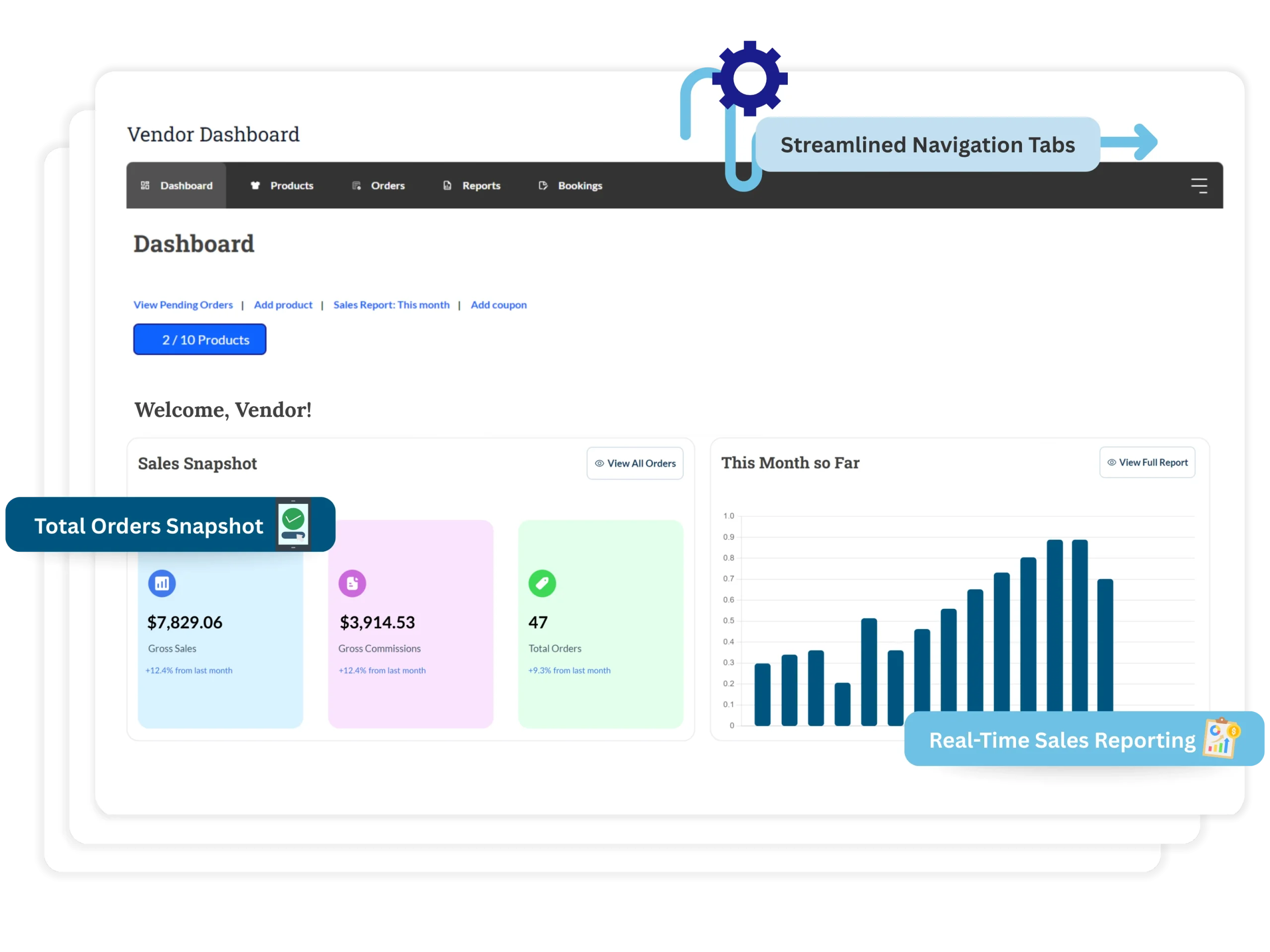
The WC Vendors marketplace dashboard gives you a centralized view of marketplace activity, with three key statistic cards showing total revenue, orders, and commissions at a glance. Use it as your daily command center instead of jumping between multiple WordPress admin pages.
Review and approve new products
Product approvals are the most time-sensitive daily task in marketplace operations management. Vendors waiting for product approval cannot sell, and delays frustrate them quickly. Set a target to process all pending product approvals within 24 hours of submission.
One thing we commonly see: marketplace owners let the product approval queue build up over several days, then spend hours clearing it. Processing approvals daily for 10 to 15 minutes is far more efficient than a weekly backlog blitz, and vendors get to start selling sooner.
Respond to vendor support requests
Vendors need answers quickly, especially new ones still learning the platform. Check your vendor support channel (email, helpdesk, or dedicated chat) at least twice daily. Even a quick acknowledgment like “I’ll look into this today” helps vendors feel less ignored while you work on the actual answer.
Handle customer inquiries
Customer inquiries about marketplace-wide issues, such as payment problems, account questions, and general product availability, fall on you rather than individual vendors. Respond to these within the same business day. Quick responses also reduce the chance that a frustrated buyer leaves a negative review that affects multiple vendors.
Weekly Tasks (2-3 Hours)
Weekly tasks focus on marketplace performance and growth. Block a specific time each week for these activities, ideally a quiet morning when you can think clearly without being interrupted by daily firefighting.
Review vendor performance metrics
Pull up your vendor performance data and look for trends. Which vendors are selling well? Which have stalled? Are any vendors receiving unusually high complaint rates or product returns? Effective marketplace operations management depends on spotting these patterns early.
For a detailed breakdown of which metrics to track, see this guide on key vendor performance metrics.
One thing we commonly see: marketplace owners only check vendor performance when a problem surfaces. By then, the vendor may have had weeks of poor ratings or declining sales that could have been addressed earlier with a quick weekly review. A 15-minute weekly check beats a crisis intervention every time.
Update marketplace content and listings
Review featured products, homepage banners, and category pages every week. Rotate featured vendors, refresh seasonal collections, and remove sold-out or discontinued products from prominent positions. Fresh marketplace content keeps buyers returning, and it signals to vendors that the platform is actively maintained.
Run marketing campaigns and promotions
Plan and launch one marketing activity per week. This could be a social media post highlighting a top vendor, an email newsletter featuring new products, or a limited-time marketplace-wide sale. Consistency matters more than scale, since a small weekly effort outperforms occasional large pushes that drain your energy.
Check financial reports and payouts
Review the week’s commission earnings, pending vendor payouts, and any disputed transactions. Make sure scheduled payouts are processed correctly and that no vendors are stuck waiting for overdue payments. Trust erodes quickly when vendors are not paid on time, and it is hard to rebuild once lost.
Monthly Tasks (Half Day)
Monthly tasks handle strategic and financial health. Block a half day each month, ideally at the start of the month when the previous month’s data is complete. This is when your marketplace operations management work shifts from tactical to strategic.
Reconcile finances and commissions
Review the full month’s financial data. Cross-check total sales against vendor payouts and marketplace commissions. Look for discrepancies between what WC Vendors reports and what your payment processor shows. Reconcile any differences before they compound into larger accounting headaches at tax time.
If you are using WC Vendors Stripe Connect, much of the heavy lifting happens automatically. Stripe splits each payment between the vendor and the marketplace at checkout, so there is no manual commission calculation. Your monthly reconciliation becomes a verification exercise rather than a calculation one.
Send vendor communications and updates
Send a monthly vendor newsletter or update. Cover marketplace performance highlights, upcoming changes, new features or policies, and recognition for top-performing vendors. Consistent communication builds vendor loyalty and reduces churn, and it positions you as a partner rather than just a platform.
For more on managing multiple vendors at scale, that guide covers vendor relationship tactics in detail and complements the operations cadence outlined here.
Review and update platform settings
Check your marketplace settings monthly. Review commission rates, shipping policies, product category structure, and any automated rules. Settings that made sense three months ago may need adjusting as your marketplace evolves and your vendor mix changes.
Analyze traffic and conversion analytics
Dig into your marketplace analytics for the full month. Look at traffic trends, conversion rates, top-selling product categories, and buyer behavior patterns. Compare against the previous month and identify what is improving and what is declining. When the numbers reveal a drop-off on either the buyer or vendor side, our guide to marketplace conversion rate optimization breaks down exactly where those leaks happen and how to close them. These insights inform your strategy for the next month.
Quarterly Tasks (Full Day)
Quarterly reviews keep the marketplace competitive and aligned with longer-term goals. Block a full day once per quarter for strategic work that does not fit into the monthly cadence. This is where good marketplace operations management becomes great.
Run vendor satisfaction surveys
Send a short survey to all active vendors. Ask about their experience, pain points, feature requests, and overall satisfaction with your platform. This feedback reveals problems you might not see from the admin side, and it gives quieter vendors a chance to share concerns they would not raise in a support ticket.
Keep surveys brief (five questions maximum) and include at least one open-ended question so vendors can share specifics. Long surveys get abandoned, but short ones with a clear purpose get strong response rates.
Review pricing and commission structures
Evaluate whether your current commission rates, listing fees, and vendor tier pricing still make sense. Compare against marketplace benchmarks and competitor pricing in your niche. Adjust rates if needed, but communicate changes to vendors well in advance, since surprise pricing changes are one of the fastest ways to lose vendor trust.
Conduct competitor analysis
Spend time exploring competing marketplaces in your niche. What features have they added? How are they attracting vendors? What does their buyer experience look like? The exercise is not about copying competitors but about understanding where the market is heading and where you can differentiate.
Plan feature updates and improvements
Based on vendor feedback, competitor analysis, and your own operational experience, identify the top three to five improvements to make in the next quarter. Prioritize changes that reduce operational overhead or directly improve buyer and vendor experience. Both pay off compounding returns.
Tools And Automation Tips
Automation reduces your daily task load so you can focus on growth instead of maintenance. Smart automation is the difference between marketplace operations management that scales and marketplace operations management that traps you in admin work forever.
WC Vendors Pro includes several features that automate routine operations. The WC Vendors Stripe Connect integration automatically splits each payment between the vendor and the marketplace at checkout, so commission payouts happen without manual intervention. Email notifications for order events (including new-order alerts to vendors in core, plus invoice and shipment-confirmation emails in Pro) and configurable payout schedules (daily, weekly, fortnightly, or monthly) further reduce manual work.
Beyond WC Vendors, consider these automation layers:
- Email automation: Set up triggered emails for vendor onboarding, payout confirmations, and inactive vendor re-engagement using a WordPress email plugin
- Helpdesk system: Route vendor support requests through a ticketing system so nothing falls through the cracks
- Scheduled reports: Configure weekly email summaries of key marketplace metrics, so you do not have to log in to check
- Monitoring alerts: Set up notifications for unusual activity, like a sudden spike in refund requests or a vendor receiving multiple negative reviews
Start with the tasks you do daily that follow a consistent pattern. Those are the highest-leverage candidates for automation because the time savings compound week after week.
The goal is not to automate everything. It is to automate repetitive tasks so your time goes toward the decisions only a human marketplace owner can make, such as vendor strategy, partnerships, and platform direction.
Build Your Marketplace Operations Schedule
Structured marketplace operations management is not about adding more work to your plate. It is about doing the right work at the right time so nothing important falls through the cracks. Most marketplace owners already do most of these tasks. They just do them reactively, in whatever order the day throws at them. The shift from reactive to scheduled work is what separates marketplaces that scale from marketplaces that stall.
Here’s what we covered in this article:
- Why Your Marketplace Needs An Operations Schedule
- Daily Tasks (30-60 Minutes)
- Weekly Tasks (2-3 Hours)
- Monthly Tasks (Half Day)
- Quarterly Tasks (Full Day)
- Tools And Automation Tips
When each task has a designated time, none of them gets squeezed out by the loudest fire of the moment, and your marketplace operations management becomes predictable rather than chaotic.
WC Vendors marketplace dashboard centralizes the data you need for daily, weekly, and monthly operations in one place. If you are still jumping between admin pages to monitor your marketplace, that is the easiest place to start improving your marketplace operations management today.
Frequently Asked Questions
How much time should I spend on marketplace operations each day?
Plan for 30 to 60 minutes of daily marketplace operations management work for a marketplace with up to 50 active vendors. As your vendor count grows, daily operations may take 1 to 2 hours. If you are consistently spending more than 2 hours daily on reactive tasks, that is a signal to invest in automation or hire vendor support.
What marketplace tasks should I automate first?
Start with the highest-frequency, lowest-judgment tasks: payout processing, order notification emails, and product approval for trusted vendors. These tasks eat the most time while requiring the least decision-making. Commission calculations and payment splits through WC Vendors Stripe Connect are already automated, so focus your additional automation efforts on the manual tasks around them.
How do I handle vendor disputes efficiently?
Establish a clear dispute-resolution process before your first dispute arises. Document the steps in your vendor handbook, set response-time expectations (e.g., initial response within 24 hours and resolution within 72 hours), and keep written records of every interaction. Most vendor disputes stem from miscommunication about policies, so clear documentation prevents most of them before they start.
When should I hire help for marketplace operations?
Consider hiring dedicated vendor support when daily operations consistently take more than 2 hours, or when you have 50+ active vendors. The first hire should handle vendor onboarding, product approvals, and day-to-day vendor questions. That hire frees you to focus on growth, partnerships, and marketplace strategy, which are the activities that actually scale revenue.
How do I track vendor performance effectively?
Use WC Vendors’ built-in reporting for sales data, commission tracking, and product performance by vendor. Supplement with Google Analytics for traffic and behavior metrics. Review vendor performance weekly using a consistent set of metrics: sales volume, product quality (return rates), customer ratings, and listing activity. Consistency in what you measure matters as much as the measurements themselves.