Choosing between a WooCommerce plugin and a standalone platform is one of the biggest decisions a marketplace builder makes. Pick the wrong approach and you are either locked into an expensive proprietary ecosystem or rebuilding from scratch a year later. The stakes in this WC Vendors vs CS-Cart decision are real, and the cost gap between these two options is enormous.
This WC Vendors vs CS-Cart comparison breaks down the differences that actually matter: total cost of ownership, customization, ease of use, scalability, and long-term flexibility. By the end, you will see why the WC Vendors vs CS-Cart decision tilts heavily toward WC Vendors for the vast majority of marketplace builders.
Two Different Approaches To Marketplace Building
CS-Cart Multi-Vendor and WC Vendors represent fundamentally different philosophies for building a marketplace.
WC Vendors
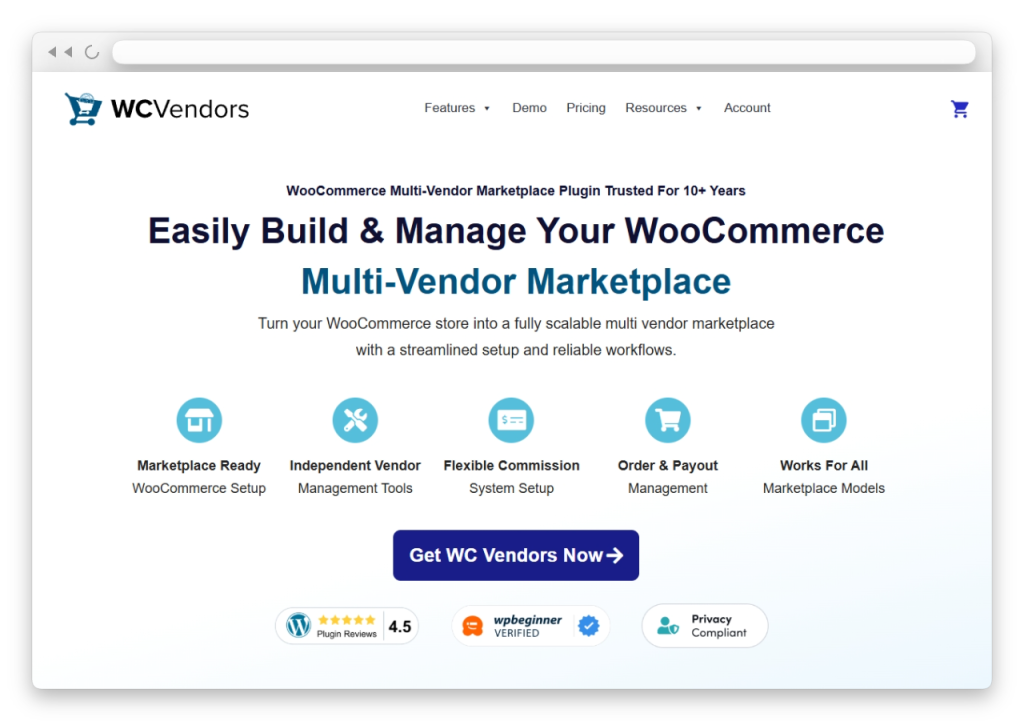
It’s a WooCommerce plugin that layers full multi-vendor marketplace functionality on top of WordPress and WooCommerce. This gives you immediate access to an ecosystem of more than 60,000 plugins and thousands of themes. Your marketplace runs on WordPress, the platform that powers around 42.5% of all websites globally. That is a structural advantage no other marketplace solution can match.
CS-Cart Multi-Vendor
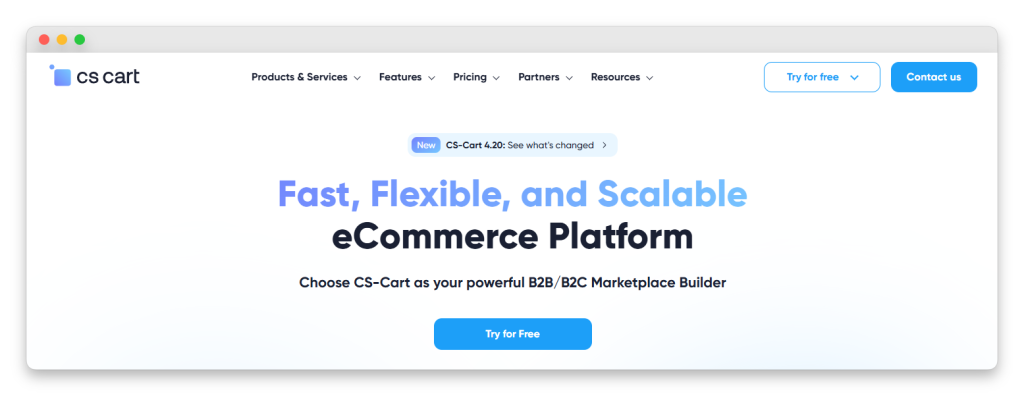
This is a standalone platform with its own CMS, admin panel, theming system, and proprietary add-on store. Nothing connects it to WordPress or WooCommerce. You install it on a server, then manage every product, vendor, theme, and integration through CS-Cart’s own interface, using developers who know CS-Cart’s framework specifically.
This distinction touches every part of your marketplace, from licensing fees to how quickly you can find a developer when something breaks. In the WC Vendors vs CS-Cart matchup, that ecosystem gap is where WC Vendors pulls ahead immediately.
Quick Comparison: WC Vendors Vs CS-Cart Multi-Vendor
Here are the key differences at a glance:
- Approach: WC Vendors is a WooCommerce plugin; CS-Cart is a standalone proprietary platform
- Starting price: WC Vendors Free ($0) or Pro at $99.50 per year; CS-Cart Standard at $61 per month billed annually ($732/year), with Plus lifetime at $3,590 and Ultimate lifetime at $7,990
- Recurring costs: WC Vendors Pro renews at $99.50 per year; CS-Cart subscriptions renew at the same rate or require paid update subscriptions after the included window
- Ecosystem: WordPress with 60,000+ plugins; CS-Cart’s smaller proprietary App Market
- Hosting: Any WordPress-compatible host (cheap shared hosts work for small stores); self-hosted with higher server requirements
- Vendor limits: Unlimited on every WC Vendors plan including the free version; unlimited on CS-Cart
- Customization: Open WordPress and WooCommerce ecosystem with millions of developers; CS-Cart’s proprietary framework with a much smaller specialist pool
Pricing And Total Cost Of Ownership
Pricing is where the WC Vendors vs CS-Cart gap becomes impossible to ignore, and it sets the tone for every other comparison that follows.
WC Vendors pricing is straightforward and predictable:
- Free: $0
- Pro: $99.50 per year
- Growth: $199.50 per year
- Business: $299.50 per year
CS-Cart Multi-Vendor pricing as listed on the CS-Cart pricing page tells a very different story:
- Standard subscription: $61 per month, billed annually ($732 per year)
- Plus subscription: $121 per month ($1,452 per year), or $3,590 lifetime
- Ultimate subscription: $300 per month ($3,600 per year), or $7,990 lifetime
- Lifetime: $19,990 once, with extra fees afterward for continued updates
Total cost of ownership
Here is what a three-year total cost of ownership comparison looks like in practical terms:
- WC Vendors Pro (3 years): $99.50 x 3 = $298.50, plus shared WordPress hosting around $360 over three years, totaling roughly $658
- CS-Cart Standard subscription (3 years): $732 x 3 = $2,196, plus higher-spec hosting at around $720 over three years, totaling roughly $2,916
- CS-Cart Plus lifetime (3 years): $3,590 upfront, plus paid update renewals after year one (typically several hundred to over a thousand dollars per year), plus hosting around $720, easily landing past $5,000 even before any custom development
The lifetime license trap is real. Verified Capterra reviews flag that CS-Cart’s lifetime license lets you keep using the software but stops free updates after the included period, requiring an additional annual subscription to continue receiving them. That fact rarely makes it into the marketing pages but matters enormously to total cost.
For context, the global retail ecommerce market reached around $6.42 trillion in 2025 and is forecast to grow to $6.88 trillion in 2026 with Statista’s worldwide ecommerce outlook projecting continued growth through 2029. Marketplace builders entering this enormous market need every dollar of budget directed toward vendor acquisition, marketing, and inventory, not toward proprietary licensing fees.
Customization And Flexibility
WC Vendors gives you the entire WordPress and WooCommerce ecosystem on day one. WordPress.org alone hosts more than 60,000 free plugins, with thousands more premium themes and extensions across the broader marketplace.
CS-Cart relies on its own App Market, which sells extensions built specifically for the CS-Cart framework. That catalog is smaller, and pricing for individual add-ons can be steep. That stacking-fee model adds up fast, especially for features that come free in the WordPress world.
The developer pool is the other side of this equation, and it matters more than most people expect. WordPress developers are everywhere because WordPress runs nearly half the web. Posting a job for a WC Vendors customization gets you dozens of qualified responses within hours.
Finding a CS-Cart specialist takes longer and typically costs more per hour because the platform’s smaller share of the market means a smaller talent pool. For long-term maintenance, this difference shows up every time you need a tweak, a fix, or a new integration.
WC Vendors itself is built on WordPress coding standards, which means any competent WordPress developer can extend it. With CS-Cart, you need someone fluent in CS-Cart’s proprietary framework specifically, and rates reflect that scarcity.
Ease Of Use
WC Vendors runs on the WordPress admin interface that millions of website owners already know. If you have ever managed a WordPress site, the WC Vendors settings will feel intuitive within minutes. Beyond that, vendors interact with a polished frontend dashboard, so they never need to touch the WordPress admin at all. Their day-to-day looks like a clean store management portal, not a CMS.
With CS-Cart admin panel, its navigation patterns, terminology, and workflow are all proprietary, with nothing carried over from any other tool. The learning curve hits both you as the marketplace administrator and your vendors who manage their own products and orders.
For marketplace owners already living in the WordPress ecosystem, adding WC Vendors to an existing WooCommerce installation is the path of least resistance. Bolting WC Vendors onto a familiar setup is dramatically faster than learning an entirely new platform from scratch. WC Vendors vs CS-Cart usability matchup: familiarity wins.
Scalability And Performance
Both platforms can power large-scale marketplaces, but how you scale and what it costs to scale look completely different. WC Vendors vs CS-Cart difference here shows up most clearly on your hosting invoice.
With WC Vendors, you control your hosting and optimize as needed. Start on a budget shared host, move to managed WordPress hosting once traffic grows. And then scale to dedicated servers, cloud platforms, or specialized WooCommerce hosting when your marketplace demands it. This flexibility means you never pay for more capacity than you actually use. The WordPress hosting market is also fiercely competitive, which keeps prices honest across all tiers.
💡 When you reach that managed WordPress stage, we recommend Levamo (formerly Rapyd Cloud) — hosting purpose-built for the database-heavy load of a multi-vendor marketplace. Plans start at $29/month, with free migration and no traffic-based overage fees, so you step up to marketplace-grade performance exactly when traffic justifies it.
CS-Cart is also self-hosted, but its server requirements are higher than those of a comparable WordPress installation. Independent reviews on G2’s CS-Cart Multi-Vendor page note that out of the box the platform needs professional tuning, with caching and a CDN required to handle high-traffic stores effectively. In translation: hosting bills are higher, and you usually need paid expertise to wring acceptable performance out of it.
The WordPress hosting ecosystem also benefits from two decades of refinement around caching plugins, CDN integrations, image optimization, and managed platforms tuned specifically for WooCommerce traffic. That depth of optimization infrastructure simply does not exist at the same scale for CS-Cart’s smaller user base. Choosing WC Vendors vs CS-Cart for performance reasons means tapping into a much deeper performance toolkit.
Hosting And Data Ownership
WC Vendors gives you complete ownership of your marketplace data and code. WordPress and WooCommerce are open source under GPL, WC Vendors runs on your hosting account on your server with your data, and you can migrate to any WordPress-compatible host whenever you want. Vendor lock-in at the platform level basically does not exist.
CS-Cart is also self-hosted, which counts in its favor compared to fully hosted SaaS platforms. You control your data and your server. However, the code itself is proprietary, governed by CS-Cart’s licensing terms. Even if you can modify it, you remain inside CS-Cart’s framework, and walking away means rebuilding your marketplace on a completely different platform from scratch.
Switching hosting providers under WC Vendors is a standard WordPress migration. Thousands of guides, automated migration tools, and specialized migration services exist for exactly this process. Moving a CS-Cart installation, by contrast, is a niche operation that almost always requires CS-Cart-specific expertise, which raises the cost and reduces your options.
Support And Ecosystem
WC Vendors comes with dedicated email support, a comprehensive knowledge base, automatic updates, and the broader WordPress community behind it. Priority support is included on the Growth and Business plans. Outside the official channels, the WordPress community provides forums, tutorials, YouTube walkthroughs, Stack Exchange threads, and developer resources covering virtually every scenario you will run into.
CS-Cart offers its own support channels, official documentation, and a community forum. Support quality is professional, but the smaller user base means fewer community-generated resources, fewer independent tutorials, and a thinner pool of third-party guides when you need answers fast at 2 a.m.
According to Statista’s ecommerce outlook, online sales are expected to make up 21.1% of total retail sales in 2026, climbing to 22.5% by 2028. Marketplace issues need fast resolution because every hour of downtime is lost sales, and a platform with a massive support ecosystem behind it shortens that resolution time dramatically.
If you want a deeper feature breakdown, the WC Vendors team has published useful background reading on the benefits of commission levels for marketplaces and how to build a WooCommerce marketplace. Both reinforce why the WC Vendors vs CS-Cart decision usually comes down to which ecosystem you want behind you.
Which Platform Should You Choose?
WC Vendors is the clear winner for almost every marketplace builder. It costs a small fraction of CS-Cart, runs on the world’s most popular CMS, taps into more than 60,000 plugins, gives you a millions-strong developer pool, and never locks you into a proprietary licensing structure.
CS-Cart is a purpose-built standalone platform. For very specific organizations with deep budgets, dedicated in-house technical staff already trained on CS-Cart. But the cost gap, the smaller ecosystem, the steeper learning curve, and the proprietary lock-in make it nearly impossible to justify against WC Vendors for everyday marketplace projects.
Build Your Marketplace On WordPress And Save
WC Vendors delivers everything CS-Cart does for marketplace management, plus the entire WordPress ecosystem, lower hosting costs, a millions-strong developer community, no surprise licensing fees, and zero proprietary frameworks to learn from scratch.
Here is a quick recap of what this article covered:
- Two different approaches to marketplace building
- Quick comparison: WC Vendors vs Cs-Cart Multi-Vendor
- Pricing and total cost of ownership
- Customization and flexibility
- Ease of use
- Scalability and performance
- Hosting and data ownership
- Support and ecosystem
- Which platform should you choose?
Ready to build your marketplace without the multi-thousand-dollar price tag? See the WC Vendors pricing page and start for free, or upgrade to Pro at $99.50 per year backed by a 14-day money-back guarantee.
Frequently Asked Questions
WC Vendors vs CS-Cart: Is CS-Cart better than WooCommerce for marketplaces?
No. While CS-Cart is purpose-built for marketplaces, WooCommerce paired with WC Vendors delivers comparable marketplace functionality at a fraction of the cost. WC Vendors offers unlimited vendors, multiple commission structures, and Stripe Connect integration for $99.50 per year. CS-Cart’s Plus lifetime license alone starts at $3,590, and Ultimate runs $7,990 lifetime. The WooCommerce ecosystem also unlocks far more customization through the 60,000-plus available WordPress plugins.
Can WC Vendors handle large-scale marketplaces?
Yes. WC Vendors powers thousands of marketplaces and supports unlimited vendors on every plan, including the free version. The plugin runs on top of WooCommerce, which is one of the most widely used ecommerce platforms in the world. Scaling is handled through your hosting infrastructure, giving you complete control over performance optimization as your marketplace grows.
Is CS-Cart worth the licensing fees?
For most marketplace builders, no. The license fee, whether $61 per month subscription or $3,590 lifetime for Plus, does not include hosting, paid update renewals after the included window, or the higher server resources CS-Cart requires for solid performance. A WooCommerce marketplace with WC Vendors Pro hits comparable functionality at $99.50 per year, with the added benefit of WordPress’s flexibility and developer availability.
Can I migrate from CS-Cart to WooCommerce?
Yes, though it does require planning. Product data, customer information, and order history can be exported from CS-Cart and imported into WooCommerce using established import tools. The vendor-specific marketplace configuration will need to be rebuilt inside WC Vendors. Given the moving parts, most store owners hire a developer or use a migration service to handle the transition cleanly.
Which option is better for beginners?
WC Vendors is significantly better for beginners. You can start with the free version on WordPress, the platform millions of people already know, add unlimited vendors at zero cost, and upgrade to Pro at $99.50 per year when you are ready. CS-Cart requires either an ongoing $61-per-month subscription or a $3,590 lifetime fee before you have built anything, plus a learning curve for its unfamiliar admin interface.