Almost every guide to ecommerce liability insurance is written for a solo seller buying a policy for their own products. Very little of it speaks to the person who hosts other people’s products, takes the payment, and gets the angry email. That gap matters, because the law in both the European Union and the United States has been moving toward platforms.
This guide explains who is liable when a vendor’s product causes harm, and what ecommerce liability insurance exists for each party. It then covers how to require coverage from your vendors, what to check on the paperwork they send, and how to build the requirement into the terms they accept before listing. It also covers the product safety duties a marketplace carries on its own, regardless of what insurance its vendors hold.
One thing first: This is not legal or insurance advice. Liability rules differ enormously by country and product category, so seek professional advice for your jurisdiction.
Who Is Actually Liable For A Vendor’s Product
Usually the vendor, sometimes you, and the answer depends less on what your terms say than on how your marketplace actually behaves.
Product liability follows a chain. The manufacturer sits at one end, and a person harmed by a defective product can normally claim against them first. Where the manufacturer sits outside the jurisdiction, the chain moves along to whoever brought the product in and whoever put it in front of the buyer.
The European Union’s new Product Liability Directive spells that chain out. According to the European Commission, a manufacturer based outside the EU remains liable, but a victim can also claim against the importer or the authorized representative established in the EU. Where there is no importer or authorized representative, the claim can go to the fulfillment service provider. A victim can ask the distributor to identify the EU-based liable party. If no such party exists, or the distributor does not respond within one month, the victim can claim against the distributor itself.
Your marketplace can land anywhere along that chain. The Commission states that online platforms can be held liable when they act, for the defective product, as one of the economic operators the directive defines: manufacturer, importer, authorized representative, fulfillment service provider, or distributor. A platform acting as a mere intermediary can still be liable under specific conditions linked to the Digital Services Act, in which case it carries the same obligation as a distributor.
Two more details in the directive matter to marketplaces. The directive covers all types of software, including applications and AI systems, so a marketplace selling digital products is within its scope. The directive also treats a substantially modified product, such as a remanufactured one, as a new product, and the person who modified it becomes its manufacturer. A vendor that refurbishes or customizes goods can therefore assume the manufacturer’s liability.
What the United States regulator decided about fulfillment
The United States has no single federal product liability statute, and claims mostly run through state law. Federal product safety rules still show where regulators draw the line, and fulfillment is where they drew it.
In a July 2024 decision, the US Consumer Product Safety Commission voted unanimously that Amazon was a distributor under the Consumer Product Safety Act for certain hazardous products sold by third-party sellers through its Fulfilled by Amazon program, and therefore bore legal responsibility for their recall. The products included carbon monoxide detectors, hair dryers and children’s sleepwear. Amazon had argued that it was only a third-party logistics provider. In January 2025, the Commission issued a final order requiring Amazon to notify purchasers and offer refunds to remove the products from consumers’ homes.
Few WooCommerce marketplaces run warehouses at that scale. The principle still travels: once a platform receives, stores and ships a seller’s goods, regulators are far less willing to treat it as a bystander.
The difference between a venue and a retailer of record
A venue introduces a buyer to a seller. A retailer of record sells the goods. The more your marketplace does the second thing, the weaker the first argument becomes.
Four things tend to push a marketplace toward retailer of record:
- You take the payment. Money reaches your account before the vendor’s, which looks like a sale you made.
- Your branding wraps the listing. The product page, the confirmation email, and the card statement carry your name.
- Returns and complaints come to you. If your team resolves the problem, you were more than an introduction.
- You store or ship the goods. Holding stock moves you closer to a distributor than to a noticeboard, as the Amazon decision shows.
None of those four is a reason to run a worse marketplace. Payment control and a single checkout are why buyers trust multi-vendor sites at all, and they are also the facts a lawyer would reach for.
What the customer thinks they bought
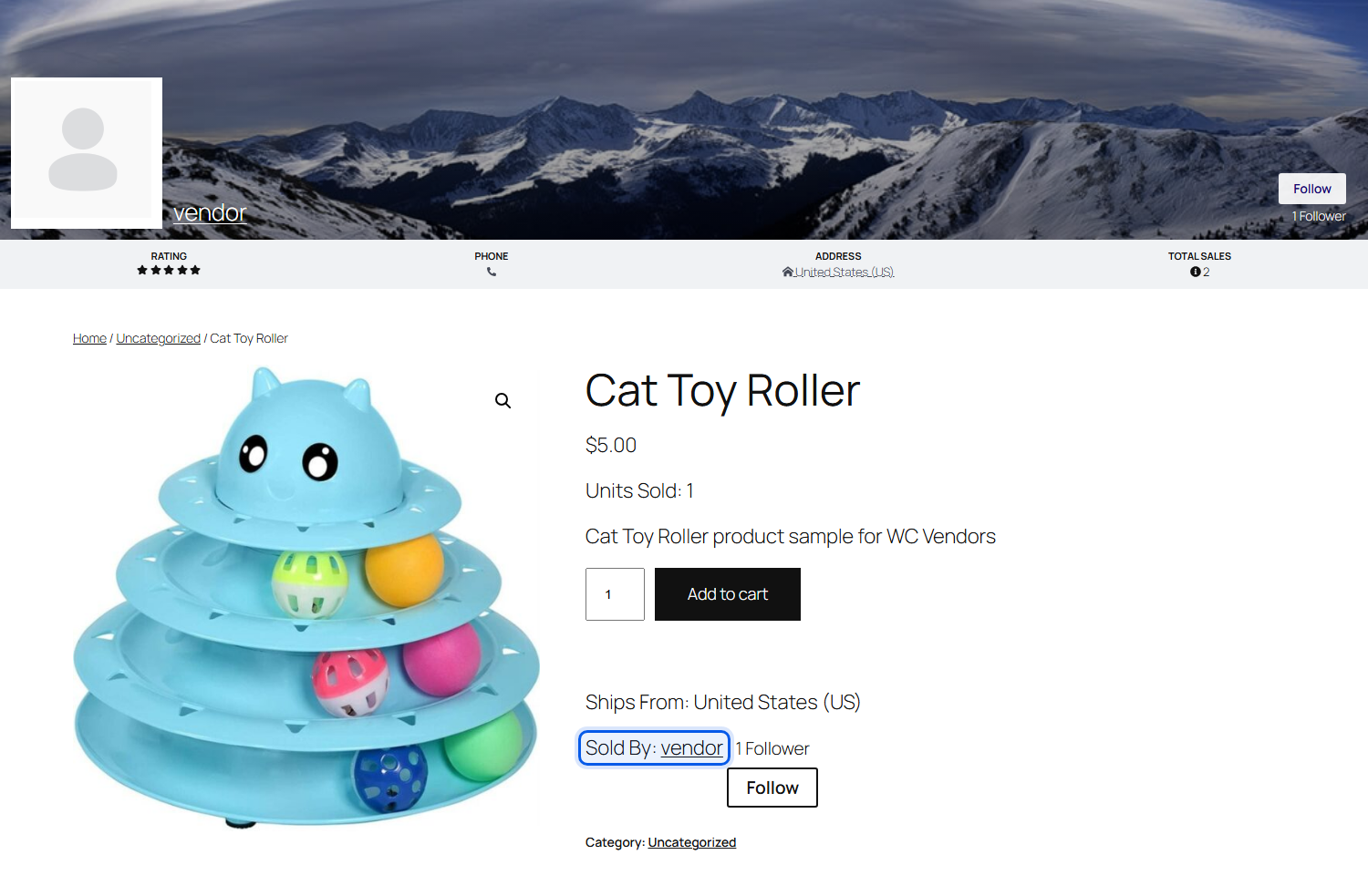
Customers rarely separate your marketplace from the vendor who fulfilled the order. They bought from your site, so they come back to your site.
A buyer who believes they bought from you will send their complaint, their chargeback and their lawyer’s letter to you first. That happens even when your terms say the vendor is the seller. You may be able to pass it along, but you will still be the one who has to. Our guide to handling marketplace chargebacks covers the payment side of that problem.
Clear vendor attribution helps. Show the vendor’s store name on the product page, give each vendor a store page of their own, and let vendors publish their own shipping and return policies. That puts the relationship in front of the buyer before they order, not after something goes wrong.
The Types Of Ecommerce Liability Insurance And Who Carries Them
Four types of ecommerce liability insurance come up repeatedly around marketplaces: product liability, general liability, cyber, and professional indemnity for vendors selling services rather than goods.
Here is a general picture of how they usually split, offered as an illustration rather than as a recommendation for your business:
| Coverage type | Protects against | Who typically carries it |
|---|---|---|
| Product liability | Injury or damage caused by a product | Vendor, sometimes required by the marketplace |
| General liability | Third-party injury or property damage | Both parties, in different forms |
| Cyber | Data breach, ransomware, payment data loss | Marketplace operator |
| Professional indemnity | Errors in advice or service delivery | Service vendors |
Product liability coverage matters most in a goods marketplace because it covers the scenario nobody plans for: something sold on your site hurts somebody. It normally sits with whoever made or imported the item, which is the vendor rather than you. In practice, it is often bundled into a commercial general liability policy, so check the policy wording rather than the policy name.
General liability is broader and less product-specific. Cyber coverage is the one operators most often forget. It is also the only coverage on that list that clearly belongs to you, because the customer database, the payment flow, and the login layer are all yours. If that side of the risk is new to you, our guide to WooCommerce marketplace security covers the controls that reduce the underlying exposure.
Professional indemnity only matters when your vendors sell time and expertise. A marketplace of photographers, tutors or trades has almost no product liability exposure and plenty of professional exposure. A policy list copied from a goods marketplace aims at the wrong risk.
Occurrence and claims-made policies
Liability policies are generally written on one of two bases. An occurrence policy responds to incidents that happened while the policy was in force, even if the claim arrives years later. A claims-made policy responds to claims made while the policy is in force, which usually means you need continuous renewal to stay protected.
The difference matters because product claims can arrive long after the sale. Under the new EU directive, economic operators remain liable for 10 years after placing a product on the market. If a vendor holds a claims-made policy and later lets it lapse, a claim arriving after that may not be covered. Ask a broker which basis suits your vendors, and consider stating a preference in your terms.
Two honest limits belong here. We are not an insurer or a broker, and WC Vendors does not provide or arrange coverage of any kind. Premiums and available limits vary by country, product category, turnover, and claims history. Treat any figure you read online as a starting point for a broker conversation, not a number to budget against.
Requiring Ecommerce Liability Insurance From Your Vendors
Requiring vendors to carry their own ecommerce liability insurance shifts the risk to the party that actually made or imported the item, where it belongs.
Large marketplaces have done this for years, and Amazon’s published requirement is a useful reference point. At the time of writing, section 9 of Amazon’s Business Solutions Agreement requires a seller to obtain commercial liability insurance within 30 days of exceeding $10,000 in gross proceeds in a single month on Amazon.com. Amazon’s stated criteria include limits of at least $1 million per occurrence and in the aggregate, a policy written on an occurrence basis, and Amazon named as an additional insured. The insurer must also give Amazon at least 30 days’ notice of cancellation, modification or nonrenewal. Thresholds and criteria differ between platforms and change over time, so check any platform’s current seller documentation before modeling your own terms on it.
Vendor requirements are also no longer purely a commercial choice. Under United States federal law, the INFORM Consumers Act requires an online marketplace to collect bank account, contact, and tax identification details from what it calls a high-volume third-party seller. That means a seller with 200 or more discrete sales of new or unused consumer products and $5,000 or more in gross revenue, in any continuous 12-month period during the previous 24 months.
The obligations continue after collection. Sellers must provide the information within 10 days of qualifying, and the marketplace must verify it within 10 days of collecting it. At least once a year, the marketplace must remind these sellers to keep their details current and require them to certify any changes. The marketplace must suspend a seller who does not comply after notice and a 10-day window to respond. Once a high-volume seller reaches $20,000 or more in annual gross revenue on the platform, the marketplace must disclose their name, physical address, and contact details to consumers. The section took effect 180 days after December 29, 2022, and the Federal Trade Commission and state attorneys general enforce it.
One detail links straight back to the retailer-of-record question. When counting a seller’s sales, the Act only requires a marketplace to count transactions made through the marketplace for which it processed the payment, directly or through its payment processor. Taking the payment is precisely what brings a seller’s volume into your compliance picture.
Whether that statute reaches your marketplace is a legal question rather than a technical one. What it shows is that “we only host listings” is already not a complete answer to a regulator.
Choosing a threshold rather than a blanket rule
A blanket insurance requirement for every vendor from day one will cost you vendors, and most of the risk doesn’t sit with the small ones anyway.
Two filters work better than a flat rule. The first is turnover, mirroring the large platforms: no requirement until a vendor’s sales pass a level you set, then a requirement within a fixed window. The second is product category, because electrical goods, children’s products, cosmetics, and anything ingested carry more claim risk than a print or a knitted hat.
One thing we see repeatedly: Operators write an insurance requirement into their terms, collect a certificate at signup, then never look at it again. Twelve months later the policy has lapsed, the vendor is still selling, and the file in your drive says everything is fine. A requirement is only as good as the thing that re-checks it, so put a renewal date in a calendar the day you accept the certificate.
What to check on a certificate of insurance
Ask for a certificate of insurance rather than a screenshot or a policy number. A certificate names the insurer, the insured party, the coverage types, the limits and the policy period in one document.
Several details are worth checking when it arrives:
- The insured name. Confirm it matches the business you approved, not a related company or an individual.
- The coverage types and limits. Make sure product liability is actually included and the limits meet the minimum in your terms.
- The policy period. Record the expiry date somewhere that will prompt you before it passes.
- The territory. Check that the policy covers the countries the vendor sells into, because coverage written for one country often stops at its border.
- Your status on the policy. If your terms ask to be named as an additional insured, check that the certificate says so.
- The deductible and the policy basis. A very high deductible or a claims-made basis may leave less protection than the headline limit suggests.
Your vetting process is the natural home for all of this. If you already run a vendor verification process before a vendor can list, an insurance check is one more item in it. The requirement should also sit alongside your published marketplace policies, so vendors meet it before they apply.
Writing The Requirement Into Your Vendor Agreement
An ecommerce liability insurance requirement only bites if it sits in the terms a vendor accepts before they can list, and if something re-checks it after they do.
Keep the clause narrow. A workable insurance clause names who must carry coverage, which types, and the minimum limits you have chosen. It sets out what proof you require and how often. It also covers whether the vendor or insurer must tell you if a policy is canceled or changed, whether you are named as an additional insured, and how long the obligation runs after a vendor leaves. For the rest of the document, our explainer on what is a vendor contract covers the wider structure.
How WC Vendors supports the workflow
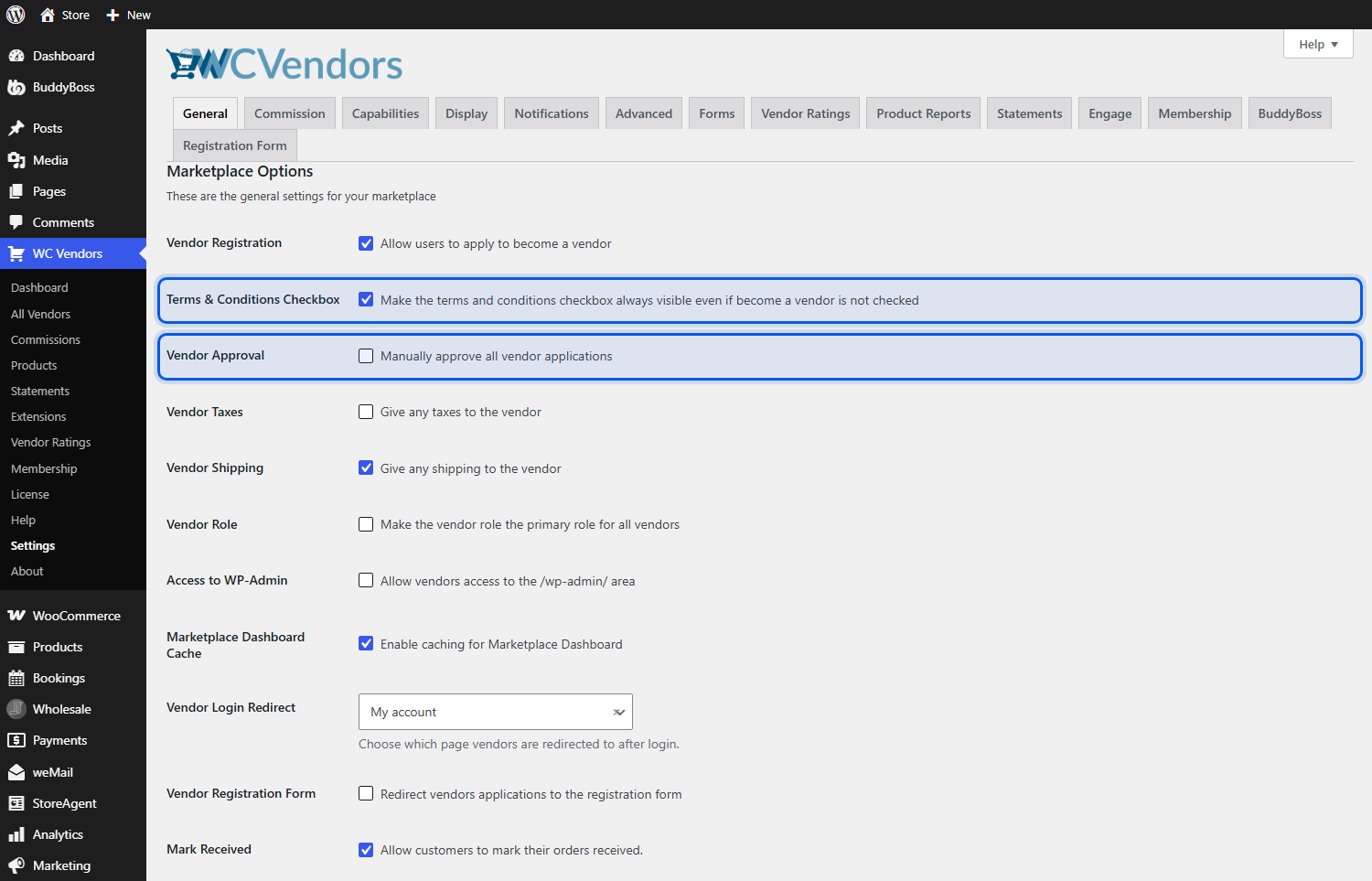
Getting the clause agreed is a product question, and this is where the platform does real work. WC Vendors includes a Terms and Conditions checkbox in its general settings, which applicants must tick before they can submit their vendor registration. Link it to your terms page from the display settings, and the checkbox will not appear until you select a page.
Manual vendor approval sits in the same settings screen. With it enabled, each applicant waits as a pending vendor until you approve or deny them from the All Vendors screen. That gives you a gate to hold a vendor at while a certificate is outstanding. Both options are available in the core WC Vendors plugin and carry through to WC Vendors Pro.
If you want to collect the certificate at the point of application, WC Vendors Signup adds a drag-and-drop form builder for your vendor registration form. You can add custom fields, including file uploads, so applicants can attach their certificate when they apply. Signup is included in the Growth and Business plans.
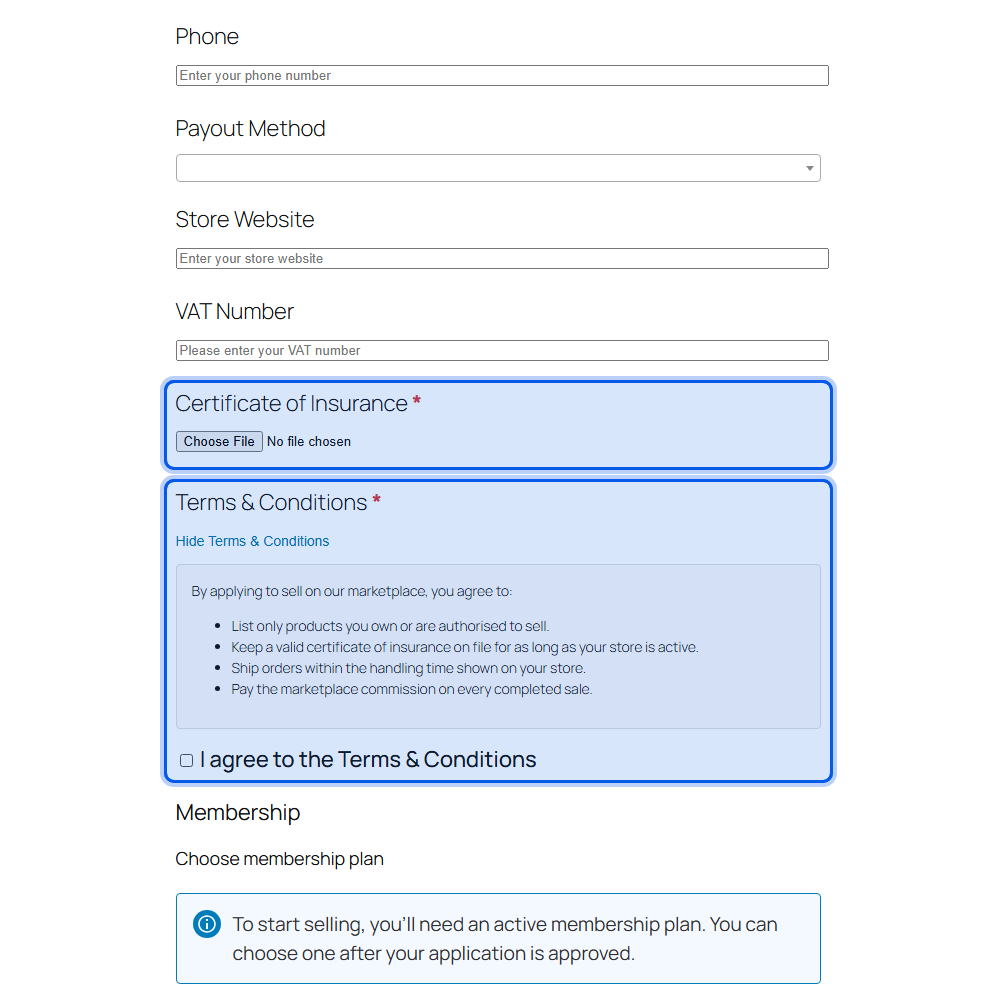
The division of labor is worth stating plainly. We give you the terms checkbox, the registration form and the approval step. We do not provide, arrange, underwrite, or check insurance; WC Vendors does not track policy expiry dates, and no plugin can tell you what coverage your marketplace needs.
Handling vendors who joined before the requirement
Store owners often ask us what to do about vendors who signed up years before the requirement existed. A deadline works better than a purge: announce it, give existing vendors a reasonable window to produce a certificate, and hold new listings rather than pulling live ones.
When I have set up a vendor registration flow, what struck me is how much weight a single acceptance checkbox carries. The vendor ticks it once and nothing in the system revisits it, which is why the follow-up has to live in your operating routine rather than your plugin settings.
Your Own Product Safety Obligations As A Marketplace
Vendor coverage pays claims after harm happens. It does not discharge the duties some laws now place on marketplaces directly, and the clearest example is the European Union’s General Product Safety Regulation.
According to the European Parliament’s legislative summary, the regulation has applied since December 13, 2024 and covers online businesses and online marketplaces as well as traditional economic operators. Marketplaces must cooperate with market surveillance authorities when they detect a dangerous product and must set up a single point of contact for product safety. Authorities can order a marketplace to remove content offering a dangerous product, disable access to it or display a warning. The marketplace must act without undue delay, and in any event within two working days of receiving the order.
If you sell into the EU, those duties sit with you regardless of what your vendors’ policies say. Build them into your operations the same way you build in the insurance check: a named person, a documented process, and a response time you can actually meet.
Where Ecommerce Liability Insurance For Marketplaces Is Heading
Platform liability is tightening, and the clearest signal is the European Union’s new Product Liability Directive.
According to the European Commission, that directive entered into force on December 8, 2024, and EU countries have until December 9, 2026 to transpose it into national law. It applies to products placed on the market from December 9, 2026, while the 1985 directive continues to apply to products placed on the market before that date. Economic operators remain liable for a defective product for 10 years after it is placed on the market, extended to 25 years in certain health-related cases where damage takes longer to appear. A victim has 3 years to bring a claim.
The directive’s definition of damage is also broad. Personal injury explicitly includes psychological harm, and damage to property sits alongside the destruction or corruption of data. That last category is worth noting for marketplaces selling software, apps or connected devices.
Scale explains the attention. According to the US Census Bureau, United States retail ecommerce sales reached an estimated $340.2 billion in the second quarter of 2026, seasonally adjusted, or 17.1% of total retail sales. That was 12.2% higher than the same quarter a year earlier. When that much buying runs through online channels, regulators look at the platforms in the middle.
Read the direction rather than the detail. Whether any of these rules reaches your marketplace depends on where you sell, what you sell and how you operate, which is a question for a lawyer in your jurisdiction. What is clear is that “we are only the venue” is a narrower defense than it used to be, which makes vendor ecommerce liability insurance more valuable to you.
Making Ecommerce Liability Insurance Part Of Your Vendor Terms
The question that marketplace owner asked about the faulty heater does not have a one-line answer, and that is the point. Your exposure depends on where you sell, what your vendors sell, and how much of the transaction you touch. Payment, branding, returns and fulfillment all pull you along the liability chain, and regulators in both the European Union and the United States have been making that chain harder to step off.
Requiring ecommerce liability insurance from your vendors is also a quality filter, and day to day that may be the more useful thing about it. A vendor who can produce a current certificate in the approved business name has a real business behind them and an insurer who has already assessed them. Vendors who cannot are the ones most likely to generate the problems coverage exists for.
That makes it one of the cheapest risk controls available to a marketplace operator. It costs you a clause, a checkbox, an approval step and a renewal date in a spreadsheet. Pair it with the coverage that is genuinely yours, especially cyber, and with the product safety processes some laws now expect from you directly. Then take the whole picture to a lawyer and a broker in your jurisdiction, and set up the terms checkbox and approval step in WC Vendors or WC Vendors Pro so the requirement applies from the first application.
Here’s what we covered in this article:
- Who is actually liable for a vendor’s product
- The types of ecommerce liability insurance and who carries them
- Requiring ecommerce liability insurance from your vendors
- Writing the requirement into your vendor agreement
- Your own product safety obligations as a marketplace
- Where ecommerce liability insurance for marketplaces is heading
Frequently Asked Questions
Does a marketplace need its own ecommerce liability insurance?
Often yes, though rarely the same coverage a vendor needs. Your own exposure tends to sit in general liability and cyber, because the customer data, payment flow and site security are yours regardless of who made the product. Product liability normally belongs with the vendor. The right answer for any specific marketplace depends on jurisdiction, turnover and product mix, so ask a broker.
Can a marketplace require vendors to have insurance?
Yes, and large platforms do. Amazon, for example, requires commercial liability insurance once a seller passes a monthly sales threshold set out in its seller agreement. The requirement is a contractual condition of selling: you set the coverage types and minimum limits, ask for proof, and make acceptance of those terms part of the application. Many operators apply it above a sales threshold or to higher-risk product categories, so smaller sellers are not priced out of joining.
What proof of insurance should you ask vendors for?
Ask for a certificate of insurance rather than a policy number or a screenshot. A certificate names the insurer, the insured party, the coverage types, the limits and the policy period in one document. Check that the insured name matches the business you approved, record the expiry date somewhere that will prompt you, and confirm the policy covers the territories the vendor sells into.
Who is liable if a vendor sells an unsafe product?
Liability usually starts with whoever made or imported the product, and the marketplace’s position depends on how it operated. The European Commission states that online platforms can be held liable where they act as one of the economic operators defined in the new Product Liability Directive, and that a mere intermediary can still be liable under specific conditions linked to the Digital Services Act. In the United States, the Consumer Product Safety Commission found Amazon to be a distributor of certain products it fulfilled for third-party sellers. Taking payment, branding the transaction and handling fulfillment all move a marketplace closer to liability.
When does the new EU Product Liability Directive apply?
The directive entered into force on December 8, 2024. EU countries have until December 9, 2026 to transpose it into national law, and it applies to products placed on the market from that date. Products placed on the market earlier remain under the 1985 directive.
Does WC Vendors provide insurance for marketplaces?
No. WC Vendors is a WooCommerce multi-vendor platform, not an insurer or an insurance broker, and we neither provide nor arrange coverage. What WC Vendors gives you is the operational side: a terms and conditions checkbox applicants must tick before registering, and manual approval so you can hold a vendor as pending until their paperwork is in order. WC Vendors Signup adds a custom registration form with file upload fields. Buying the coverage is between your vendors and their insurers.