
“Can my sellers run their own auctions?” The answer depends far less on the auction plugin than on what it sits on top of. That distinction is why people look for an Ultimate Auction Pro alternative in the first place. Both routes covered here will put auctions on a WooCommerce store. If you are building a marketplace rather than a single-seller shop, that assumption determines how much you pay and how many moving parts you maintain.
This is an honest look at the strongest Ultimate Auction Pro alternative for vendor-run auctions, WC Vendors with WooCommerce Simple Auctions, set against Ultimate Auction Pro itself: what each one actually is, where the capability you need sits in each product’s pricing, and why a seller-managed marketplace comes out ahead on the setup that matters.
What Each Product Actually Is
WC Vendors does not ship a standalone auction engine. The bidding mechanics come from WooCommerce Simple Auctions, a mature, purpose-built auction plugin for WooCommerce. What WC Vendors Simple Auctions adds is the integration that makes those auctions work inside WC Vendors, so every seller creates and manages their own auction lots from their own frontend dashboard instead of routing everything through a site administrator.
WC Vendors setup has three parts working together: WooCommerce, WooCommerce Simple Auctions for bidding, and WC Vendors Pro with our integration for the multi-seller layer. Each piece has a clear job, and the marketplace layer is the foundation the others plug into.
Ultimate Auction Pro, from auctionplugin.net, takes the opposite path. It is a WordPress auction plugin sold in three annual tiers, built first and foremost for a single seller running auctions on one store. To let multiple sellers list their own lots, its pricing page points to a feature called Seller Auction, described there as a WCFM Marketplace integration. In plain terms, vendor auctions arrive only when you bolt their plugin onto WCFM, a separate multi-vendor plugin made by a different company.

It is fair to name the symmetry, because both routes involve a second plugin. The difference is ownership and order. Our marketplace layer is the product we built, with auctions integrated through our own code. Their marketplace support bridges to a third company’s plugin, added alongside an auction tool that was never designed around multiple sellers. That ordering decides where each product’s vendor features live and what they cost. If you are still weighing whether to build an auction website at all, settle that architectural question first.
The Vendor-Run Auction Question
Here is the single most useful thing to know before you compare anything else: on Ultimate Auction Pro, seller-run auctions are not in the entry tier. Their pricing page places Seller Auction, the WCFM Marketplace integration, in the middle Business tier.
That reshapes the decision. Buy their cheapest license expecting your vendors to list their own lots and you have bought the wrong tier, and their entry tier is also explicit that bidding there is simple bidding with no proxy support. Multi-seller auctions are a mid-tier capability in their product. In ours, they are the foundation, which is exactly why WC Vendors reads as a purpose-built Ultimate Auction Pro alternative rather than a workaround.
With WC Vendors Pro, the frontend vendor dashboard is the product. Sellers add and edit their own products, including auction lots, and see their own orders and sales without an administrator account and without visibility into anyone else’s items. Commission is taken per sale automatically. None of that is a tier upgrade, because a marketplace with one seller isn’t a marketplace.
One pattern we see constantly: an operator buys an auction plugin, gets auctions working beautifully as a single seller, then discovers that letting twenty sellers list their own lots means adding a marketplace plugin, reconciling two sets of settings, and testing which one wins when they disagree. The order you build in matters. Start from the marketplace when you know vendors are coming, because retrofitting multi-seller onto a single-seller setup is the harder, slower direction to travel.
That foundation is the same one non-auction marketplaces run on, which is a useful sanity check. Our write-up of how Sonniss scaled a trusted audio marketplace shows the seller-managed model working at real volume, with auctions as one product type among several rather than the whole system.
Feature Comparison
Both products cover the auction basics, so a row of matching ticks would tell you nothing. What matters is which tier each capability arrives at, and that is what the table below shows.
| WC Vendors Simple Auctions | Ultimate Auction Pro | |
|---|---|---|
| Vendor-run auctions | Native via WC Vendors included in Business tier | Business tier, via WCFM integration |
| Silent / sealed bidding | Supported | Unlimited tier (top tier) |
| Proxy bidding | Supported | Business tier (not in Starter) |
| Extend on bid (anti-sniping) | Supported, vendor-configurable | Business tier, listed as Soft-Close |
| Buy It Now | Supported | Business tier, as Auction + Buy Now |
| Automatic relisting | Supported | Unlimited tier |
| Plugins required | WC Vendors Pro + WooCommerce Simple Auctions | Ultimate Auction Pro + a separate multi-vendor plugin (WCFM) |
A marketplace that wants sellers running silent auctions with anti-sniping is reaching for Ultimate Auction Pro’s top tier, because silent bidding sits there while the vendor integration and soft-close sit a tier below. On the WC Vendors side, those same capabilities arrive together through the Simple Auctions integration, which is a large part of why it holds up as an Ultimate Auction Pro alternative for real marketplaces.
Sealed bidding deserves a specific mention because it makes a genuine silent auction possible, rather than a timed auction with prices on display. WC Vendors stack supports it, and we cover how sealed-bid auctions work in practice separately.

Pricing And Total Cost
Compare the total cost of the setup you actually need, not the headline prices, because the tier that supports vendor auctions isn’t the tier that either product advertises first.
Ultimate Auction Pro’s annual pricing runs in three tiers: Starter at $79 per year for one site, Business at $119 per year for three sites, and Unlimited at $199 per year for unlimited sites.
On WC Vendors pricing page, Pro costs $99.50. For Simple Auctions, it belongs on the Business tier, which costs $299.50, and yet everything in the Pro and Growth plans is already included there, and so much more.
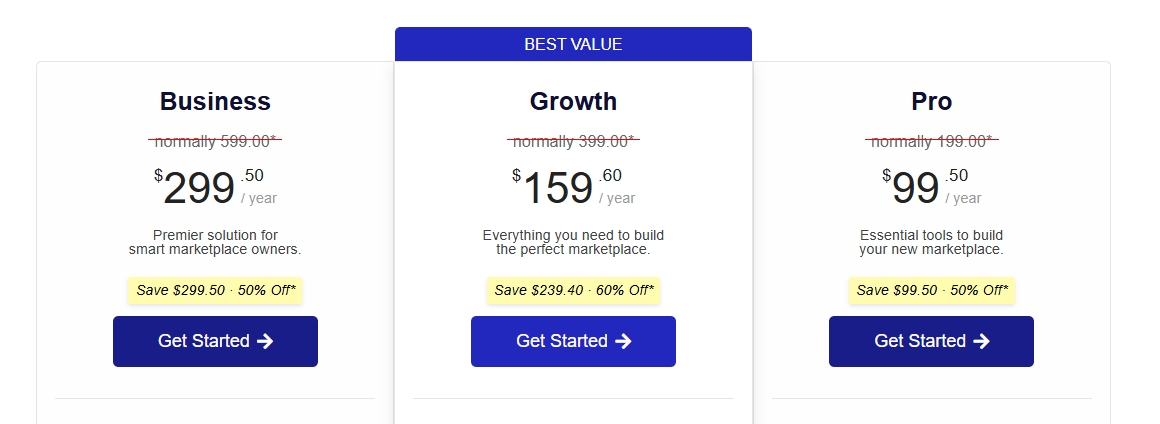
Both products sell in tiers, so the fair question isn’t who has a ladder, but where the capability you need sits on it. On the Ultimate Auction Pro side, the auction features themselves get rationed: proxy bidding and soft-close arrive at Business, and silent bidding only at Unlimited, so your auction cost is set by whichever single bidding feature you cannot do without. That is an awkward way to buy.
On the WC Vendors side, the auction capabilities come from the Simple Auctions integration rather than from climbing to a higher marketplace tier, so a buyer weighing an Ultimate Auction Pro alternative is really comparing one clean integration against a feature-by-feature tier climb. Check which plan covers that integration for your setup.
Marketplace fees, payment processing, and any per-sale commission you take all affect what an auction nets, and our breakdown of auction fees covers that side.
Support, Updates, And Who Owns The Integration
On WC Vendors stack, the bridge between WC Vendors Pro and WooCommerce Simple Auctions is our own code. When vendor auctions misbehave, we fix the integration, and we publish its changelog. On the Ultimate Auction Pro route, the bridge to WCFM is theirs, and the marketplace plugin at the far end belongs to a third company, so a fault in the seam can sit between two businesses rather than one.
Before you buy, you want to know who is accountable when the integration between two plugins fails, because that join is where multi-vendor auction problems actually happen. A single owner for that seam is a real reason the WC Vendors stack works as a dependable Ultimate Auction Pro alternative.
Why WC Vendors Is The Right Ultimate Auction Pro Alternative
If sellers will be listing their own lots, WC Vendors stack is the setup to build on. The frontend vendor dashboard is included in our entry Pro tier rather than waiting behind a mid-tier upgrade, and sealed bidding, proxy bidding, and extend-on-bid arrive together with the Simple Auctions integration instead of being rationed across a ladder.
Ultimate Auction Pro’s list runs longer in two places, notifications and auction-house payment behaviors, and it is worth knowing that before you commit either way. For a marketplace, those solve problems you mostly do not have, while the problem you certainly do have, giving many sellers control of their own lots, sits behind their middle tier and a second multi-vendor plugin.
The Bottom Line For Marketplace Owners
If your site will have more than one seller listing lots, WC Vendors stack starts where it needs to. If sellers will be running their own lots on your site, see what WC Vendors Simple Auctions adds on top of WooCommerce Simple Auctions and WC Vendors Pro.
Here’s what we covered in this article:
- What each product actually is
- The vendor-run auction question
- Feature comparison
- Pricing and total cost
- Support, updates, and who owns the integration
- Why WC Vendors is the right Ultimate Auction Pro alternative
Frequently Asked Questions
What is the best Ultimate Auction Pro alternative for a multi-vendor marketplace?
For a marketplace where sellers run their own auctions, WC Vendors Pro with WooCommerce Simple Auctions is the closer fit, because multi-seller operation is the foundation rather than a tier upgrade. Sellers create and manage their own lots from day one, and the auction features come together through one integration. Ultimate Auction Pro remains a reasonable pick for a single-seller auction site.
Can vendors run silent auctions on WC Vendors?
Yes. Sealed bidding is supported in the stack, which is what makes a true silent auction possible rather than a timed auction with visible prices, and vendors create those lots from their own dashboard.
Do I need WooCommerce Simple Auctions as well as WC Vendors Pro?
Yes, and it is worth being clear about. WC Vendors Simple Auctions is the integration layer, not the auction engine. WooCommerce Simple Auctions provides the bidding mechanics and is a separate plugin you buy alongside WC Vendors Pro.
Can I switch from Ultimate Auction Pro to WC Vendors?
Products and orders live in WooCommerce, not in either plugin, so your catalog and order history stay put. Auction-specific settings and any in-flight bidding data are plugin-specific, so plan a switch between auction cycles rather than mid-auction.