On a multi-vendor marketplace, every problem has a second layer. Alcohol, vape hardware, bladed goods, and adult products are all legal to sell to some people, in some places, with the right checks. So whose job are those checks: yours or your vendor’s? Most guides to age verification ecommerce quietly assume one owner running one shop, which is exactly the setup a marketplace is not.
This article is not legal advice, and the rules genuinely differ by country, state, and product category. What follows is the operator’s playbook: which categories carry restrictions, why self-declaration fails, what real checks look like, who is likely to be treated as the retailer on your marketplace, and how to gate categories in WC Vendors before a single restricted listing goes live.
Which Categories Are Restricted, And By Whom
Restricted goods fall into four broad groups on most marketplaces: alcohol, nicotine and tobacco products, bladed and weapon-adjacent items, and adult products. Regulators treat each group differently, and they rarely agree across borders.
It helps to treat restriction as three separate questions stacked on top of each other, because a category can pass one and fail another:
- Is it legal to sell here at all? Some items are prohibited outright in particular jurisdictions, regardless of the buyer’s age.
- Who is allowed to sell it? Alcohol and tobacco usually require the seller to hold a license, and that license belongs to a named business at a named address.
- Who is allowed to buy it? This is the age threshold, and it moves. In the United States, it is illegal for a retailer to sell any tobacco product, including cigarettes, cigars, and e-cigarettes, to anyone under 21, according to the FDA. Many other countries set that line at 18.
Bladed goods are the group operators most often miss. Age thresholds for knives and bladed articles are set nationally and sometimes locally, and several jurisdictions add conditions for remote sales that do not apply face to face. Adult products carry a different complication: requirements in this area have been moving quickly, and the newer ones are often written for platforms rather than individual shops.
Nicotine deserves its own note. The FDA regulates tobacco products containing nicotine from any source, including synthetic nicotine, so nicotine pouches and vape liquids do not sit outside the rules just because of how the nicotine was made.
Your own rules sit on top of all of this. Nothing obliges you to allow a category just because it is legal somewhere, and every age verification ecommerce obligation you take on starts with that decision. Write down which categories you permit, which you prohibit, and which need specific approval, then publish that list alongside your other marketplace policies so vendors see it before they apply.
Why An Age Gate Is Not Compliance
A date-of-birth popup proves nothing. It records an unverified claim made by the one person with a reason to lie, and regulators do not treat a self-declaration as a check.
Real verification has two parts, and tools that only handle the first are the ones that get stores into trouble:
- Establishing that a date of birth is genuine, by reading a government-issued identity document or querying an authoritative data source rather than a text field.
- Binding that record to the person in front of you, so the document belongs to this buyer and not to a photo of someone’s older brother.
A third gap catches marketplaces hardest, because it opens after the money has moved. Verifying at checkout does nothing if the parcel is then handed to whoever answers the door.
The evidence on that gap is unflattering. A mystery-shopping study of online alcohol sales in Estonia, published in Public Health in Practice in 2025, completed 91 test purchases between August and September 2024. Overall, 81.3% of orders were delivered without any ID validation, and courier deliveries performed worse than parcel lockers, at 87.5% versus 66.7%.
The purchase stage was no better. In the same study, 40.7% of test orders asked for no age confirmation at all, and where a check did appear, it was usually a self-reported click confirming the buyer was 18 or older. Registration with a personal ID code or electronic ID was required for only about 1% of purchases.
One detail matters for reading those numbers fairly. The test buyers were 18 and 19 years old, which is above Estonia’s legal drinking age of 18, so the study measured whether anyone checked ID rather than whether minors were actually served. For an operator, that is precisely the point: a handover that waves adults through without a glance at their ID would likely wave a 16-year-old through as well.
So the timing of the check matters as much as the check itself. Depending on the category and the jurisdiction, the moment that counts may be at order, at dispatch, at handover, or several of those at once.
What Real Age Verification Ecommerce Checks Look Like
Once you accept that self-declaration does not count, the next question is what does. Age verification ecommerce checks generally fall into four families, and the strongest setups combine more than one.
| Method | What it checks | Where it usually fits |
|---|---|---|
| Database check | Matches the buyer’s name, date of birth, and address against commercially available records | At order, before payment is captured |
| Document and selfie check | Reads a government-issued ID and compares it with a live image of the buyer | At order or account creation, for higher-risk categories |
| Digital or electronic ID | Confirms age through a government-backed or bank-issued digital identity | At order, in countries where such schemes are widely used |
| Adult signature with ID at delivery | A courier confirms the recipient’s age in person and records a signature | At handover |
United States vape sales show how these combine in practice. Congress extended the PACT Act to electronic nicotine delivery systems in December 2020, and ATF guidance for tobacco sellers says delivery sellers must verify each customer’s age using one or more commercially available databases, based on the buyer’s full name, birth date, and residential address. They must also ship using a method that collects an adult signature and proof of age at delivery.
The paperwork side is just as demanding. Delivery sellers register with the ATF, file reports with state tobacco tax administrators, and keep detailed records of each delivery sale until the end of the fourth full calendar year after it. Violations can bring fines, up to three years in prison, or both.
That combination, a data check at order and an ID check at handover, is a useful template even outside nicotine. A dedicated verification provider handles the first part. The second part depends on carriers, which is where many marketplaces discover a gap, as the shipping section below explains.
What about the privacy risk of collecting ID?
Operators are right to be wary of hoarding identity documents, and United States regulators have addressed part of that worry directly. On February 25, 2026, the Federal Trade Commission issued a COPPA enforcement policy statement saying it will not bring an enforcement action under the COPPA Rule against operators of general audience and mixed audience services that collect personal information solely to determine a user’s age, without first obtaining verifiable parental consent.
That forbearance comes with conditions, and they also serve as a sensible specification for any age-verification ecommerce setup, wherever you operate. Use the data only to determine age, keep it only as long as needed, delete it promptly afterward, and disclose it only to third parties you have verified can protect it. Give clear notice, apply reasonable security, and take reasonable steps to confirm your method is likely to be accurate.
Read the statement for what it is, though. COPPA protects children under 13, so the statement removes a specific privacy-law disincentive to running age checks. It is not a safe harbor for selling restricted goods to the wrong person, and the FTC has said it stays in effect only until the Commission publishes final rule amendments on age verification, or withdraws it.
Who Is The Retailer On A Marketplace?
On many marketplaces, the vendor is treated as the seller, not the operator. That answer lulls operators into thinking the obligation has been handed off. It has not, because platforms carry their own duties in parallel, and the way your payments flow can make you look more like the seller than you expect.
Two questions get run together here, and separating them is the single most useful thing you can do:
- Who sold the goods? Ordinarily, the vendor whose listing it was, particularly where that vendor holds the license and is clearly presented to buyers as the seller.
- What is the platform itself obliged to do? This is a separate question with its own answer, and it does not depend on who sold what.
Now consider how the money moves. In the standard WC Vendors setup, the customer pays the marketplace at checkout through whichever WooCommerce gateway you run, and WC Vendors records each vendor’s commission as due for payout. In other words, the full order value usually lands in your account first. With split payments through a vendor-compatible gateway, as our guide to marketplace payments explains, vendors can be paid at the time of sale, but you still choose the gateway and hold the platform relationship.
Neither setup automatically makes you the seller, and neither keeps you out of the transaction. This is a question for your lawyer, with your actual payment flow in front of them.
United States federal law already answers the platform question in a related context. The INFORM Consumers Act, in effect since June 27, 2023, requires online marketplaces to collect, verify, and in some cases disclose information about their high-volume third-party sellers. According to the FTC’s business guidance, a seller qualifies as high-volume after 200 or more sales and $5,000 or more in gross revenue in any continuous 12-month period within the past 24 months.
Only sales where the marketplace processed the payment, directly or through its processor, count toward that threshold. Marketplaces must also have those sellers certify their information at least once a year, and violations could result in civil penalties of $53,088 per violation.
That payment detail matters on a WC Vendors marketplace, because you are usually the one processing payments. And if you already have to verify who your bigger sellers are, extending that record to cover which restricted categories each one is licensed for is a small addition to work you cannot avoid.
Your payment processor takes an even simpler view. Restricted categories sit on prohibited or restricted lists at most acquirers, and the merchant relationship is yours, so account consequences typically land on you regardless of which vendor made the sale.
Penalties are concrete, too. For underage tobacco sales, the FDA publishes an escalating ladder of maximum civil money penalties on its enforcement page. A first violation brings a warning letter, followed by up to $365 for a second within 12 months, $727 for a third within 24 months, $2,920 for a fourth within 24 months, $7,300 for a fifth within 36 months, and $14,602 for a sixth within 48 months.
The current maximum for a single violation of the FD&C Act relating to tobacco products is $21,903, and the FDA issues warning letters to online retailers and physical stores. Retailers with five or more repeated violations within 36 months can also face a no-tobacco-sale order, which bars tobacco sales at that location for a set period.
Here’s how the split usually falls on a marketplace, though it moves with your jurisdiction, your payment setup, and what your vendor agreement says (illustrative example):
| Check | Who performs it | Who is accountable |
|---|---|---|
| Category permitted on the marketplace at all | Operator | Operator |
| Vendor licensed to sell that category | Vendor supplies proof, operator verifies | Both |
| Buyer’s age verified before the sale completes | Verification provider, configured by whoever controls checkout (usually the operator on a WooCommerce marketplace) | Seller of record, with the operator sharing exposure if it runs checkout |
| Buyer’s age verified at handover | Carrier or courier | Vendor, plus the carrier under its own terms |
| Carrier will accept the goods at all | Vendor | Vendor |
| Processor permits the category | Operator applies, processor decides | Operator |
| Marketplace-level seller records and disclosures | Operator | Operator |
How To Gate Restricted Categories In WC Vendors
Your strongest control is the one furthest upstream: deciding which categories exist on your marketplace, and approving vendors into them individually before they can list anything.
Be clear about one thing first. WC Vendors does not provide buyer age verification, and no multi-vendor plugin should be your age check. Verification belongs to a dedicated third-party provider in your stack. WC Vendors gives you the upstream half of age-verification ecommerce compliance: control over who sells, what they must tell you before they sell, and where their products can ship.
Here’s the order that works.
Step 1: Decide the category list before you open registration
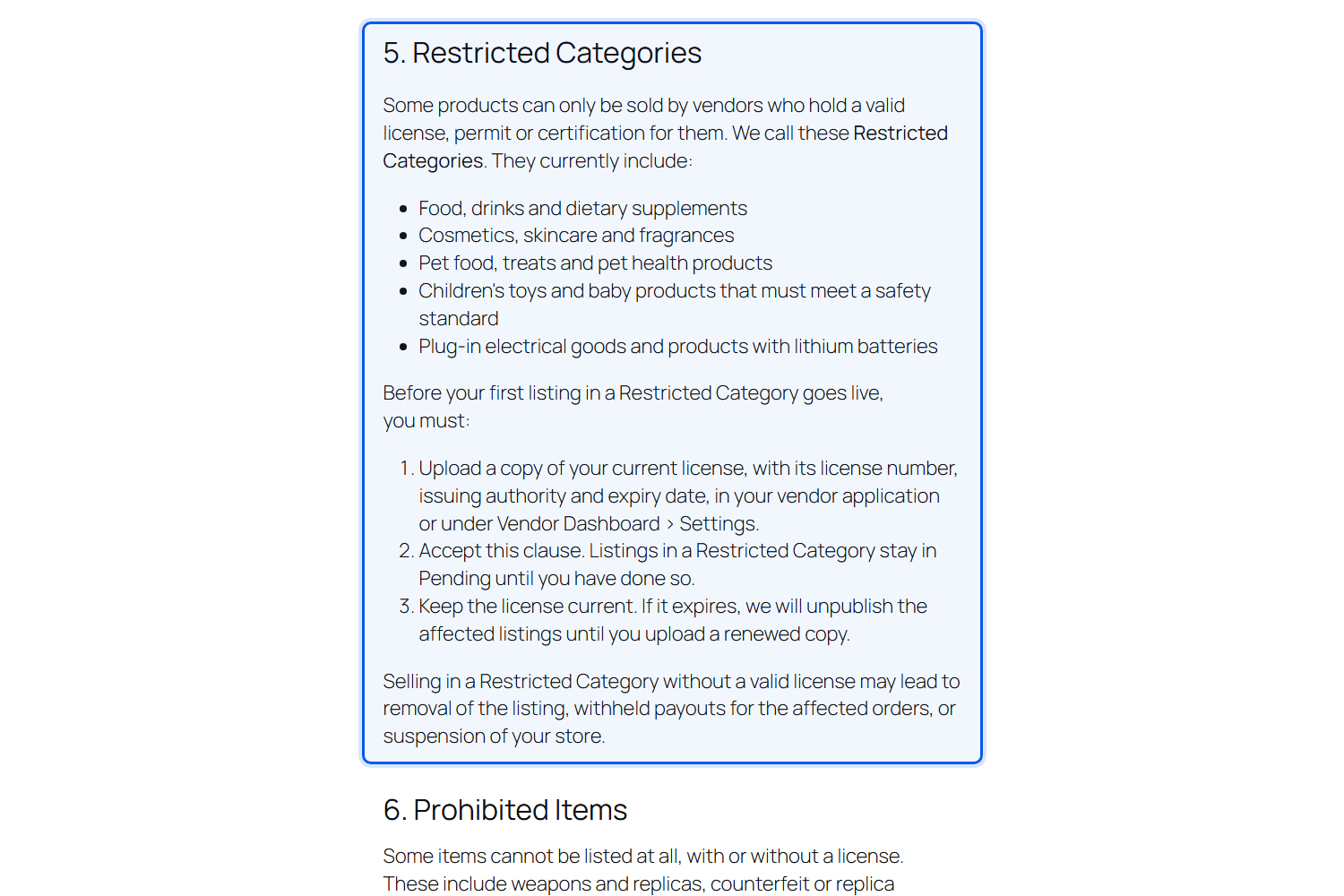
Write your permitted, prohibited, and approval-only categories into your marketplace terms. Say plainly that a restricted category needs specific permission, and that listing outside a vendor’s approved categories is grounds for removal.
Step 2: Turn on manual vendor approval
In your WordPress dashboard, go to WC Vendors > Settings > General. Enable Vendor Registration so people can apply, enable Vendor Registration Form so applicants have to complete a form, and enable Vendor Approval so every applicant lands as a Pending Vendor instead of going live. For the form to appear, WooCommerce must also allow customers to create an account on the My Account page, which you set under WooCommerce > Settings > Accounts & Privacy.
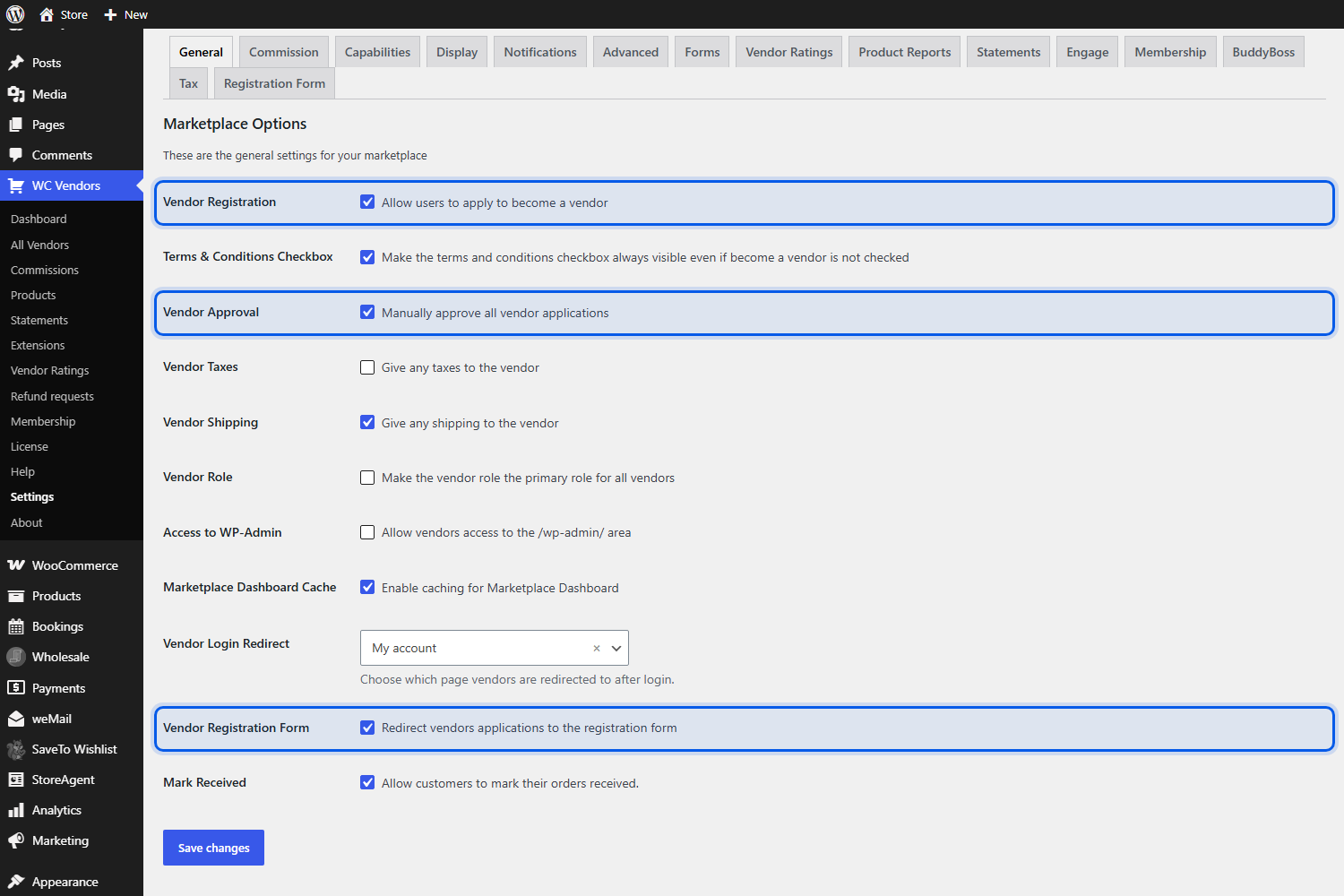
Pending Vendors cannot use vendor tools, so nothing gets listed until you act. To review an applicant, open Users > All Users, click their username to see what they submitted, then hover over the name and choose Approve or Deny. Our guide to vendor approval walks through each setting with screenshots.
Step 3: Ask the license question in the application itself
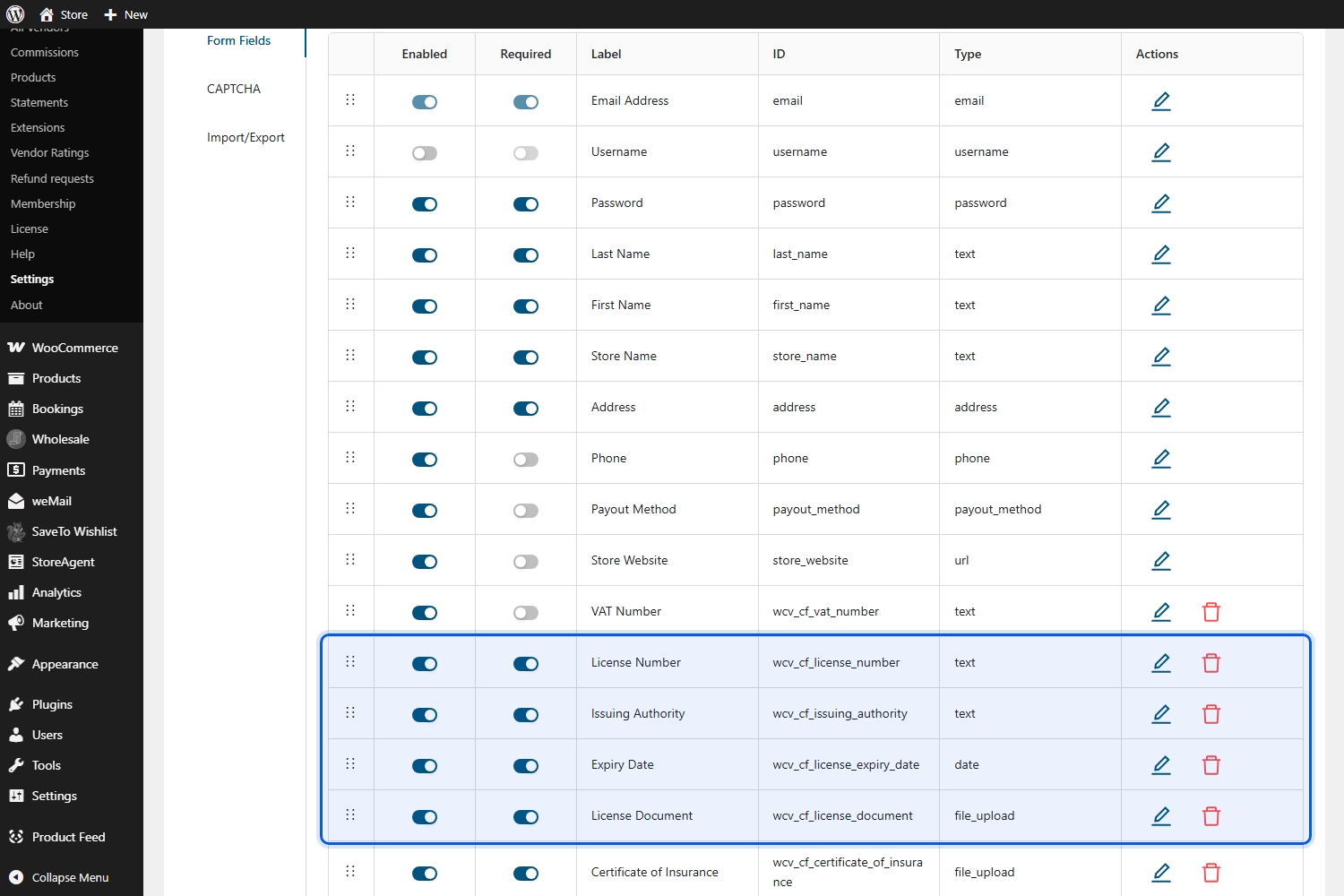
Whatever you fail to ask before approval, you will chase by email afterward. For restricted categories, collect the license number, the issuing authority, the expiry date, the exact legal entity the license belongs to, and a copy of the license itself.
The default registration form will not capture all of that. WC Vendors Signup adds a drag-and-drop form builder inside WordPress admin, with text fields, dropdowns, checkboxes, and file uploads, plus a dedicated vendor registration page and an approvals system. It is included in the Growth and Business plans rather than Pro, so factor that in if restricted categories are central to your marketplace.
Step 4: Verify before you approve
Check the license against the issuing authority’s public register, where one exists; confirm the entity name matches the applicant’s business details; and verify their identity alongside it. Our guide to building a vendor verification process covers the identity side. The Growth plan also includes verified sellers, which, as our marketplace security guide describes, gives you a built-in way to designate trusted sellers and surface their verification status.
Step 5: Restrict where restricted products can ship
With WC Vendors Pro, go to WooCommerce > Settings > Shipping > Vendor Shipping, find Method availability, and choose Specific Countries to limit vendor shipping to destinations you have researched. Country table rate shipping also supports rules by state and by postcode.
Two caveats apply, both covered in our knowledge base article on how to restrict shipping to certain countries. Rates you set under WooCommerce > Settings > Shipping > Shipping Zones still apply even when they are missing from the vendor shipping settings, so audit your zones as well. The Method availability setting also covers vendor shipping across the whole marketplace, not just one category, so handle a restricted category with a narrower footprint through each vendor’s shipping table and your vendor terms.
Step 6: Put the obligations in writing
A handshake is not a control. Our explainer on what is a vendor contract sets out the document these obligations belong in, and the clauses covered below are the ones that matter most for restricted goods.
Step 7: Recheck every year
Licenses expire and entities get restructured, so a permit you verified two years ago tells you nothing about today. If you are covered by INFORM, run the license review on the same cycle as the annual seller certification, so you collect everything in one pass.
Here is a useful test to run today. For each vendor currently listing a restricted product, can you produce the license number you approved them on? If the approval happened but the record did not, that is the gap to close first.
What to write into your vendor terms
Five clauses do most of the work, and each exists because a vendor might otherwise argue the point later:
- A named category list the vendor may list in, with anything outside it treated as a prohibited listing.
- License warranties for those categories, plus a duty to tell you within a set number of days if one lapses.
- Explicit allocation of the age check, naming who runs it, when, and with which provider, so there is no gap between your assumption and theirs.
- An indemnity covering penalties and costs arising from an underage sale they made.
- Suspension on suspicion, exercisable without waiting for a regulator’s finding.
Shipping, Carriers And Payment Processors
Two constraints sit entirely outside your settings: what carriers will physically move, and what your payment processor will let anyone sell. Either can veto a category you have already approved, and either can undo an otherwise solid age verification ecommerce plan.
Carriers are the blunter of the two. Cigarettes, smokeless tobacco, and electronic nicotine delivery systems are generally non-mailable through the United States Postal Service unless an exception applies and every PACT Act condition of mailability is met. Private carriers are not an easy fallback either. UPS and FedEx both stopped carrying vape products in 2021, and as recently as 2025, FedEx still refused them while DHL accepted only business shipments with prior approval.
A vape vendor on a United States marketplace therefore needs a carrier that will actually accept the goods, deliver with an adult signature and ID check, and support PACT Act compliance. They should be able to name that carrier before you approve them, and you should recheck carrier terms at every annual review.
Destination is the other half. Restricting where a category can ship is a marketplace-level decision, not something to leave to each vendor. Under the PACT Act, ATF guidance says each delivery sale must comply with state and local law as if the sale took place entirely in the destination, so a vendor shipping nationwide inherits every destination’s rules.
Payment sits underneath everything. Acquirers and gateways keep their own prohibited and restricted business lists, and they update them on their own schedule. Stripe’s list, for example, prohibits several categories of adult content and services outright and lists tobacco products and other age-restricted goods among its restricted businesses. That matters directly if you pay vendors through the WC Vendors Stripe Connect gateway included with Pro.
Read your processor’s list before approving a category, not after. Our overview of WooCommerce payment gateways for marketplace payments is a good starting point for which options suit a multi-vendor setup.
Getting Age Verification Ecommerce Right On Your Marketplace
Here’s the reframe worth taking away. Checkout is the part of age verification ecommerce you can hand to a specialist provider, and admission is the part you cannot hand to anyone. That is why an operator’s real leverage sits at the application form rather than the payment page, and why the questions you ask before approving a vendor matter more than any popup you add afterward.
Get the upstream half right, and the rest becomes a procurement decision: pick a verification provider, confirm your carriers and processor will support the category, and write the division of labor into your vendor terms. Get it wrong and no verification tool will save you, because you will not know which of your vendors was supposed to be running it, or whether they were ever licensed to sell in the first place.
The ground also keeps shifting under age verification ecommerce rules. Federal privacy guidance changed in 2026, carrier policies have moved more than once since 2021, and processor lists change without notice. Building the annual recheck into your calendar keeps your records as current as the rules they are meant to satisfy.
If restricted categories are part of your marketplace, WC Vendors gives you the controls for the upstream half of age verification ecommerce: manual vendor approval, vendor shipping restrictions with WC Vendors Pro, and custom application forms with license uploads through WC Vendors Signup on the Growth plan. Start with the application form, because that is where every one of these obligations is either captured or lost.
Here’s what we covered in this article:
- Which categories are restricted, and by whom
- Why an age gate is not compliance
- What real age verification ecommerce checks look like
- Who is the retailer on a marketplace?
- How to gate restricted categories in WC Vendors
- Shipping, carriers and payment processors
Frequently Asked Questions
Does a date-of-birth popup count as age verification?
No. A popup captures a self-declared birthday, which is an unverified claim by the person who wants the answer to be yes. Genuine verification reads a government-issued document or queries an authoritative data source, then binds that record to the buyer. Regulators and payment processors both distinguish between the two, and self-declaration offers no defense once an underage sale is found.
Who is responsible for an underage sale on a marketplace, the operator or the vendor?
Often the vendor is treated as the seller, especially where they hold the license and are presented to buyers as the seller. That does not clear the operator. Platform-level duties run in parallel, your processor holds its relationship with you, and on a typical WooCommerce marketplace the customer pays you first. Treat it as two obligations rather than one and settle in your vendor agreement which party does what. This is not legal advice, and the answer varies by jurisdiction.
Which WC Vendors plan do I need for restricted categories?
Manual vendor approval is a setting within WC Vendors itself. WC Vendors Pro adds vendor shipping controls, including country restrictions, plus the Stripe Connect gateway. The Growth plan adds WC Vendors Signup, with a custom application form builder that supports file uploads, and verified sellers. If you need applicants to upload license documents, Growth is the closer fit. At the time of writing, Pro is $99.50 for the first year (renewing at $199) and Growth is $199.50 for the first year (renewing at $399), both as introductory offers for one site.
Can I just ban restricted categories entirely?
Yes, and for many marketplaces that is the right call. Banning a category removes the licensing and verification burden completely, because a category that does not exist cannot be listed in. The honest test is whether those goods are central to your marketplace’s reason for existing. If they are a side experiment, the compliance overhead rarely pays for itself.
Does collecting ID documents create a privacy problem?
It creates a responsibility rather than a problem, provided you handle the data narrowly. The FTC’s February 2026 COPPA policy statement works as a template even outside the United States: use the data only to establish age, keep it no longer than needed, share it only with providers you have checked, give clear notice, and secure it properly. Letting a verification provider hold the documents instead of your own database achieves most of that.
Do I need different rules for each country I ship to?
In practice, yes. Age thresholds, licensing requirements, and remote-selling conditions are all set locally, so one global rule will either be unlawful somewhere or needlessly restrictive everywhere. Most operators define a small number of shipping regions per restricted category, apply the strictest applicable rule within each region, and refuse destinations they have not researched.
Do vape vendors on my marketplace have to follow the PACT Act?
If they sell electronic nicotine delivery systems remotely to consumers in the United States, the PACT Act applies to them as delivery sellers. According to ATF guidance, that means registering with the ATF, reporting to state tobacco tax administrators, verifying age through commercially available databases, shipping with an adult signature and proof of age at delivery, and keeping detailed sale records. Ask for evidence of each before approving a vape vendor. This is not legal advice.