Behind every winning bid sits a set of auction fees, the charges an auction platform sets: a listing fee when an item is posted, a final value fee taken as a percentage of the winning bid, and processing fees on the payment. On a WooCommerce marketplace running WC Vendors, the owner sets the commission taken from each vendor’s sales and decides which other fees apply.
These fees change how much buyers pay and how much sellers keep after the sale. Whether you’re using a traditional auction house or a WordPress multi vendor marketplace, it’s important to understand where these costs come from and how they’re calculated.
These fees often vary by platform, product type, and sales volume. Some charges are flat-rate, while others are tied to the final auction price. For sellers, auction fees affect profit margins. For buyers, they shape the total cost of acquisition.
This guide explains the different types of auction charges and why they exist. It also covers how vendors and marketplace owners can set them up fairly on a WooCommerce multi vendor marketplace with WC Vendors and Simple Auctions, which is useful whether you already run one or are about to build an auction website on WooCommerce.
Who Pays Auction Fees: Buyer Or Seller?
In most auctions, the seller pays the bulk of the fees. A listing or insertion fee to post the item and a final value fee taken as a percentage of the winning bid, while the buyer may pay a separate buyer’s premium or payment-processing fee. Who pays what is set by the auction platform, so it varies between marketplaces. On a WooCommerce marketplace running WC Vendors, the owner sets the commission taken from each vendor’s sales, auction sales included; buyer-side fees such as a buyer’s premium are a policy decision, not a built-in setting.
What Are Auction Fees?
Auction fees are the costs associated with selling or buying through an auction. The platform typically deducts these fees from the final sale or adds them to the winning bid.
These fees cover services like marketing, payment processing, platform usage, and vendor support. Similarly, in a WooCommerce marketplace plugin environment, these principles apply and can be customized by the admin or platform owner.
Buyer Vs. Seller Auction Charges
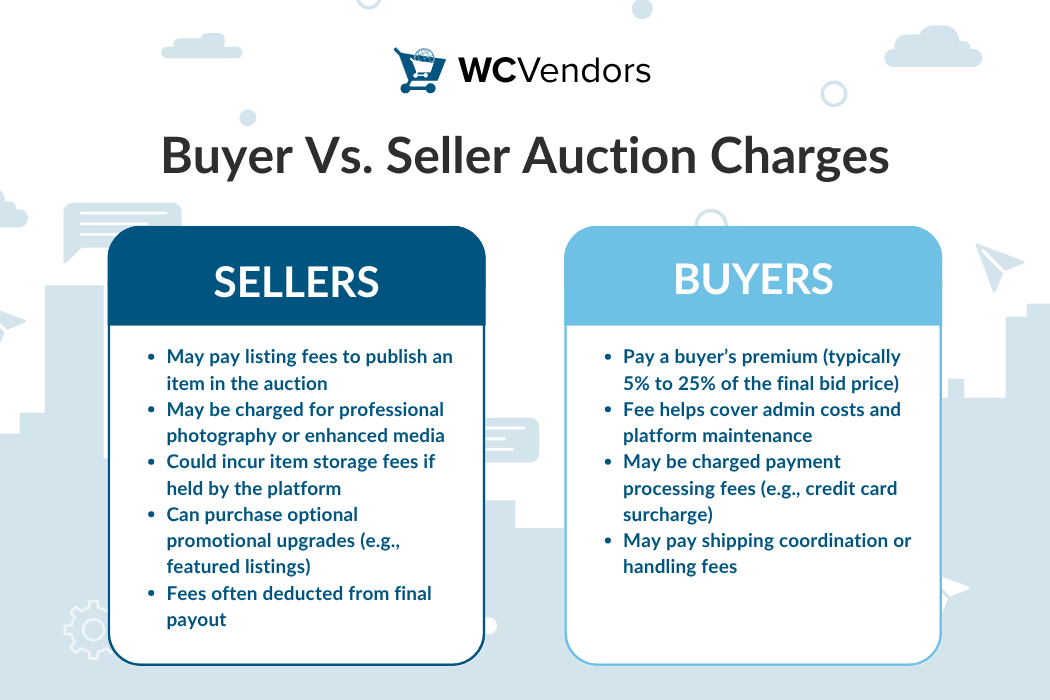
Both sides of an auction are charged fees, though the structure and purpose of those fees often differ.
Buyers typically pay a “buyer’s premium” by adding a percentage to the final auction price. This fee helps cover administrative costs and platform maintenance.
The rate depends on the auction house, the category and the price of the lot, and large houses often tier it by hammer price. Some platforms also charge buyers for payment processing or shipping coordination, which adds to the total cost.
Sellers, on the other hand, may be responsible for listing fees, professional photography, item storage, or optional promotional upgrades. These costs are often deducted from the final payout.
In a WordPress multi vendor marketplace, the seller-side fee you control directly is commission. WC Vendors Pro lets you set it globally, per vendor or per product, and anything beyond that is a rule you write into your vendor terms.
Here’s how the main fees compare and where each one lives on a WC Vendors marketplace:
| Fee | Who usually pays | Typical basis | On a WC Vendors marketplace |
|---|---|---|---|
| Seller commission | Seller (vendor) | % of the final price, agreed before the sale | Set by the owner in WC Vendors Pro commission settings (global, vendor or product) |
| Buyer’s premium | Buyer | % added to the hammer price, often tiered | Not a built-in setting; owner policy |
| Listing or insertion fee | Seller | Flat amount per listing | Not a built-in setting; owner policy |
| Payment processing | Usually the seller or platform | % plus a fixed amount per transaction | Charged by the payment gateway |
In the next section, we’ll look at how traditional and online auction houses structure their auction fees, so you can better understand how to compare or design your own fee model.
What Auction Houses Typically Charge
Auction houses charge sellers a commission and buyers a premium, then add smaller service fees around them. Here’s what’s commonly included:
- Seller’s commission: A cut of the final sale, agreed when the item is consigned
- Buyer’s premium: An additional fee paid on top of the winning bid
- Listing and marketing costs: Flat fees for catalog inclusion, photography, or digital advertising
- Storage and handling: If physical items are stored before pickup
There’s no single industry rate. According to Christie’s, the seller’s commission is agreed at consignment and can vary with the category, value and expected demand for the object, while the buyer’s premium is a percentage of the winning bid on a tiered structure.
Those tiers fall as the price rises. According to Christie’s buyer’s premium schedule, effective 1 September 2026, buyers pay 28% of the hammer price up to US$2,000,000, 22% from US$2,000,001 to US$8,000,000, and 15% above that. Each rate applies only to the part of the price inside its band.
Sellers protect themselves from low results in a different way. A reserve price is the lowest bid a seller will accept, so an item that doesn’t reach it stays unsold rather than going for a price the seller would never have agreed to.
Online platforms often mirror this system. On a WooCommerce marketplace, the part you can automate is commission, which is calculated on every sale.
How auction price affects final fees
The final sale price of an item often changes how much the seller pays in fees.
Many auction platforms use a sliding commission model. This means:
- Lower-priced items are charged a higher percentage
- Higher-priced items are charged a lower percentage
Illustrative example:
These numbers show how a sliding rate works. They aren’t any platform’s published rates.
- $5,000 item → 12% commission ($600 fee)
- $20,000 item → 8% commission ($1,600 fee)
This approach rewards high-value sellers and keeps the platform competitive.
If you’re using a WooCommerce multi vendor marketplace, you can set this up with:
- Tiered commission rules in WC Vendors Pro, which can step the rate by product price
- Per-vendor commission rates, so established sellers can work on different terms
This lets you scale your auction fees fairly across different price ranges.
Common Commission Fees And Hidden Costs

Commission fees are the most visible and expected part of auction pricing. The seller usually pays these as a percentage of the final sale to the platform or auction house. However, there are often other charges that aren’t as obvious up front.
These hidden auction fees can add up quickly and affect the final payout:
- Relisting charges: If an item doesn’t sell the first time, some platforms charge a fee to relist it in a future auction.
- Media upgrades: Vendors may pay extra for professional images, video previews, or richer product descriptions to help their listings stand out.
- Shipping coordination: If the platform offers help arranging delivery or pickup, it may come with a handling fee or service charge.
- Payment processing fees: Card and online payment services take a cut of every transaction. According to Stripe’s pricing page, its standard US rate is 2.9% + 30¢ per successful domestic card transaction, and the platform may choose to pass this on to the vendor.
For marketplace owners using a WordPress marketplace plugin, the good news is you can decide how these costs are handled. You might absorb some of them into your pricing structure, charge vendors directly, or offer them as optional upgrades. If you pay vendors through Stripe, you can also automate vendor payouts.
This flexibility allows you to keep your platform transparent and vendor-friendly, while still covering your operational expenses.
Do Auction Fees Vary By Industry?
Yes. Real estate auctions, in particular, often have different fee models due to legal and regulatory considerations.
A real estate auction might involve:
- Seller-paid marketing packages
- Flat-rate entry fees
- Government filing or inspection costs
- Buyer’s premiums that include closing coordination
Rates shift by category even inside one auction house. According to Christie’s buyer’s premium schedule, wine carries a flat 25% premium at every saleroom except Shanghai, while US online vehicle auctions run by Gooding Christie’s carry 10%.
In contrast, auctions for digital goods or collectibles might only require a listing fee and a small seller commission. Fundraising is different again: on an online silent auction for a cause, the main costs are usually payment processing and the platform itself.
Tip: What you sell often determines the fee strategy you apply. See which auction categories perform best in our list of top auction item ideas for online marketplaces.
Creating A Fair Fee Structure On Your Vendor Platform

Marketplace owners need to balance platform revenue with vendor satisfaction. Transparency helps retain sellers, while flexible fee rules support a wider range of vendor types.
A WordPress multi vendor marketplace setup lets you assign commission rules by vendor or by product, so every seller knows what to expect and what they’re paying for.
For example, you could set up a three-tier vendor structure (illustrative figures, not a recommendation):
- Basic Vendors: 15% commission on the final auction price
- Pro Vendors: 10% commission, plus a $5 listing fee per item
- Gold Vendors: 7% commission, no listing fees, but only available by subscription
Illustrative example: if a Gold vendor sells an item for $1,000 at auction, they would only pay $70 in platform fees. Meanwhile, a Basic vendor selling the same item would owe $150. This pricing strategy rewards committed sellers and encourages vendors to upgrade while keeping your platform profitable.
WC Vendors Pro can handle the commission part of a structure like this, with a different rate for each vendor. The $5 listing fee and the subscription aren’t built-in WC Vendors settings, so you’d run those as marketplace policy and spell them out in your vendor terms.
A Mistake To Avoid: Launching auctions without telling vendors that commission is taken on the final hammer price, not the starting bid. Put the commission rule in the vendor terms before the first auction goes live.
How WC Vendors Handles Commission On Auction Sales

WC Vendors handles auction fees the same way it handles every other sale: through commission. To let vendors run auctions on your marketplace with WC Vendors Simple Auctions, you add the Simple Auctions Add-on, which gives vendors an Auction product type in their frontend dashboard.
The add-on isn’t a standalone auction engine. It needs WC Vendors Pro and WooCommerce Simple Auctions by WPGenie, which is sold separately, and it’s included in the WC Vendors Business plan.
Once it’s running, each vendor sets up their own auctions. On every auction they set:
- Prices: a start price, a bid increment, a reserve price and an optional Buy It Now price
- Timing: the date and time the auction opens and closes
When an auction sells, WC Vendors pays the vendor’s commission exactly as it would on any other product, and the marketplace keeps the rest. WC Vendors Pro gives you these commission types:
- Percentage: the vendor receives a share of the sale price.
- Percentage + fee: a percentage share, minus a fixed fee.
- Fixed: the vendor receives a set amount per sale.
- Fixed + fee: a set amount, minus a fixed fee.
- Tiered: rates that change with sales by vendor, sales by product or product price.
You can set commission globally, per vendor or per product. For the full settings, see how commissions work in WC Vendors Pro.
One detail catches new owners out: in WC Vendors, the commission you enter is the vendor’s share, not the marketplace’s. The knowledge base example uses 50% with a $5 fee, and on a $100 sale the vendor receives $45 while the marketplace keeps $55. If you want to keep 15% of each auction, the vendor’s rate is 85%.
WC Vendors adds no auction-specific fee: there’s no built-in buyer’s premium and no per-listing auction charge. If you want either one, treat it as marketplace policy and state it in your buyer and vendor terms before bidding opens.
To learn how to set it all up, check out our full guide: How To Build An Auction Website with WooCommerce.

Set Auction Fees Your Vendors Can Trust
Most fee disputes on a marketplace start with a rate nobody wrote down before the gavel fell. A vendor who knows the rate in advance will usually accept it, while one who discovers it in a payout starts looking elsewhere.
On a WooCommerce multi vendor marketplace, that means settling commission in WC Vendors Pro and writing any buyer-side fee into your terms. Sensible automation elsewhere in your store then leaves you free to focus on vendors and bidders.
To recap, here’s what to do:
- Learn what auction fees are and who each one lands on.
- Compare buyer and seller charges before you decide who pays what.
- Check what auction houses charge and how price bands change the rate.
- Account for hidden costs like payment processing and relisting.
- Write a fair fee structure into your vendor terms.
- Set commission on auction sales in WC Vendors Pro.
If you’re ready to put auction fees on a footing your vendors understand, see how WC Vendors Simple Auctions works.
Frequently Asked Questions
What is the difference between auction fees and service fees?
Auction fees are charges directly tied to the auction process, such as buyer’s premiums or seller commissions. Service fees refer to additional costs like shipping coordination, credit card processing, or listing upgrades that may apply outside of the actual bidding.
Are auction fees tax-deductible?
Auction fees may be tax-deductible for sellers if they are considered business expenses. This includes listing fees, promotion costs, and commissions. Always consult a tax professional for advice based on your local regulations.
Who sets the auction fees on a multi-vendor marketplace?
The marketplace owner does. On a WooCommerce marketplace running WC Vendors Pro, the owner sets the commission on every sale, auction sales included, globally, per vendor or per product. Any buyer-side fee, such as a buyer’s premium, isn’t a built-in setting, so it’s a policy the owner decides and publishes in the marketplace terms.
How do online auction platforms calculate fees automatically?
Most platforms apply pre-set commission rules and fee schedules to the final price. On a WC Vendors marketplace, the automatic part is commission: when an auction sells, WC Vendors calculates the vendor’s commission the same way it does for any other product. Buyer’s premiums and listing fees aren’t calculated by WC Vendors.
Can vendors pass auction fees on to buyers?
Yes, vendors can pass certain auction fees on to buyers, such as shipping or payment surcharges. However, buyer premiums are typically controlled by the platform, not individual sellers. Transparent fee policies help maintain trust.
What percentage do most auctioneers take?
There’s no single standard rate. Major auction houses tier their buyer’s premium by price: according to Christie’s, it’s 28% of the hammer price up to US$2,000,000, then lower in higher bands. Seller commission is usually agreed per item. On your own marketplace, you choose the rate in your commission settings.