Deciding to build a marketplace is the easy part. The hard part starts when you open a browser tab, search for multi-vendor marketplace software, and drown in options. Hosted platforms, self-hosted plugins, no-code builders, and enterprise suites all claim to be the one you should pick.
That choice matters more than it looks, because your multi-vendor marketplace software decides what you own, what you pay every month, and how far you can grow before you hit a wall. Pick wrong and switching later means migrating your entire marketplace to a new system.
This comparison cuts through the noise. You will see the best multi-vendor marketplace software in 2026 across both self-hosted and hosted models, what each option is genuinely good at, and a clear recommendation for the platform that fits most marketplace owners.
How To Choose Multi-Vendor Marketplace Software
Choose your multi-vendor marketplace software based on four things: ownership, cost model, flexibility, and how well it scales. Feature lists blur together, but these four factors decide how the platform serves you over years, not weeks.
- Ownership: Do you own the software and data, or rent access to a hosted platform? Owning means control and portability, while renting means convenience and dependence.
- Cost model: A one-time or annual license behaves very differently from a perpetual monthly subscription, especially as your marketplace grows.
- Flexibility: Can you extend the platform with plugins, themes, and integrations, or are you limited to what it ships with out of the box?
- Scalability: Will the same software handle ten vendors and ten thousand, or force a painful migration in the middle of your growth?
Keep those four criteria in mind as you read the options below.
The Best Multi-Vendor Marketplace Software In 2026
Here is how the leading options compare across self-hosted and hosted models. Each has a clear best-fit scenario, and only one works as the default multi-vendor marketplace software for the majority of owners.
WC Vendors (on WooCommerce): Best for marketplaces
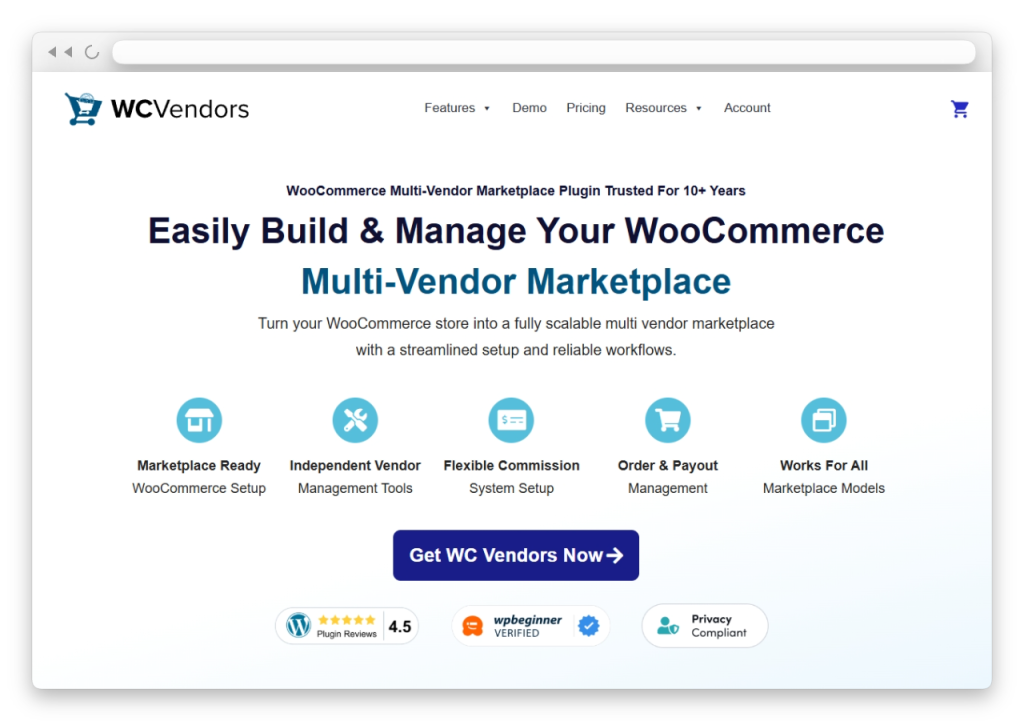
WC Vendors is the best multi-vendor marketplace software for most owners because it combines full ownership with the flexibility of the WooCommerce ecosystem. It is a plugin that turns WooCommerce, the open-source platform behind a large share of online stores, into a marketplace with vendor registration, storefronts, flexible commissions, and automated Stripe Connect payouts.
Why it leads:
- You own everything: the software, data, and hosting all belong to you.
- Predictable, lower cost: WC Vendors Pro starts at $99.50 per year, undercutting premium marketplace plugins like Dokan (from $149/year) and costing far less over time than a hosted SaaS subscription or a standalone platform license, with no perpetual monthly platform fee.
- Full flexibility: extend it with the entire WooCommerce ecosystem of plugins and themes.
- Room to grow: first-party add-ons for Auctions, Bookings, Subscriptions, and Memberships extend the same core as your marketplace matures.
Our roundup of the best WooCommerce multi-vendor plugin goes deeper on the WooCommerce-specific options.
CS-Cart Multi-Vendor
CS-Cart Multi-Vendor is a self-hosted marketplace platform that is not built on WooCommerce. It is a capable standalone product with a higher upfront license cost, and it is a fair pick if you specifically want a non-WordPress self-hosted system. The tradeoff is a smaller extension ecosystem than WooCommerce and a steeper starting price. For a side-by-side breakdown, see our WC Vendors vs CS-Cart comparison.
Sharetribe
Sharetribe is a hosted, no-code marketplace builder. Its strength is speed, since you can launch without a developer and never touch a server. The tradeoff is ownership and cost: you rent the platform on a monthly subscription, and your marketplace lives on the vendor’s infrastructure rather than your own. For a closer look at that model, see our WooCommerce vs SaaS marketplace comparison of owning versus renting.
Marketplace apps for Shopify and BigCommerce (hosted add-ons)
Third-party apps can add multi-vendor features to hosted platforms like Shopify and BigCommerce. They are convenient if you are already committed to that platform, but you inherit the host’s monthly costs, transaction considerations, and limits on customization. In effect, you are building a marketplace inside someone else’s walls.
What Makes WC Vendors The Right Choice For Most
For most marketplace owners, WC Vendors wins because it is the only multi-vendor marketplace software that pairs true ownership with a mature, extensible ecosystem at a predictable cost. Hosted platforms win on launch speed, and standalone systems suit specific non-WordPress needs. Beyond those niches, though, the majority of owners want a marketplace they control, can extend, and will not outgrow, without a monthly platform bill.
One thing we commonly see: Owners choose a hosted platform for the fast launch, then hit its limits a year in and face a full migration to a system they can actually control. Choosing an owned, extensible foundation up front avoids that expensive second move. It is worth weighing the three-year picture, not just the first week.
That is the case for building on WooCommerce with WC Vendors: you get the fast path to a real marketplace and the freedom to grow it on your terms. Our guide on how to build a multi-vendor marketplace walks through the full setup.
Which Marketplace Software Should You Choose?
If you want the honest answer for most marketplaces, it is WC Vendors on WooCommerce. This is the multi-vendor marketplace software that lets you own your platform, extend it without limits, and keep costs predictable as you scale, which is exactly what a marketplace needs to survive past its first year. Hosted builders are fine for a fast experiment, and standalone systems fit narrow non-WordPress cases. For a marketplace you intend to build into a real business, though, owning your foundation wins.
Here’s what we covered in this article:
- How to choose multi-vendor marketplace software
- The best multi-vendor marketplace software in 2026
- What makes WC Vendors the right choice for most
Ready to build on software you own? Get started with WC Vendors Pro and launch a marketplace that grows with you.
Frequently Asked Questions
What is the best multi-vendor marketplace software?
For most owners, WC Vendors on WooCommerce is the best multi-vendor marketplace software because it combines full ownership, a predictable annual cost, and the flexibility of the WooCommerce ecosystem.
Is self-hosted or hosted marketplace software better?
It depends on what you value. Self-hosted multi-vendor marketplace software like WC Vendors on WooCommerce gives you ownership, flexibility, and a predictable cost, at the price of managing your own hosting. Hosted software launches faster and handles infrastructure for you, but you rent it monthly and give up control. Most owners building for the long term choose self-hosted.
How much does multi-vendor marketplace software cost?
It varies widely by model. Self-hosted options like WC Vendors Pro start around $99.50 per year plus your own hosting, while hosted SaaS platforms charge a recurring monthly subscription that continues for as long as you operate. Over a few years, the owned model is typically the lower total cost.
Can I move between marketplace platforms later?
You can, but it is easier from some platforms than others. Self-hosted, WooCommerce-based multi-vendor marketplace software keeps your data in your own database, so exporting and migrating is straightforward. Moving off a hosted platform means extracting your data from the vendor’s system first, which is one reason many owners choose an owned foundation from the start.