Most marketplace businesses fail. The idea is rarely the problem. The real issue is that the operator never pressure-tested the model before building. They picked a technology stack, recruited a handful of vendors, and launched into silence, all because they skipped the economics, the vendor acquisition strategy, and the competitive landscape on paper first. This is what happens if you don’t have a good established marketplace business plan.
According to Failory’s startup analysis, roughly 90% of startups fail, and marketplaces carry an even higher mortality rate in their first two years. The failure mode is almost always the same: underfunded, underplanned, or unable to solve the cold-start problem. A marketplace business plan won’t guarantee success, but it forces you to answer the hard questions before you spend money.
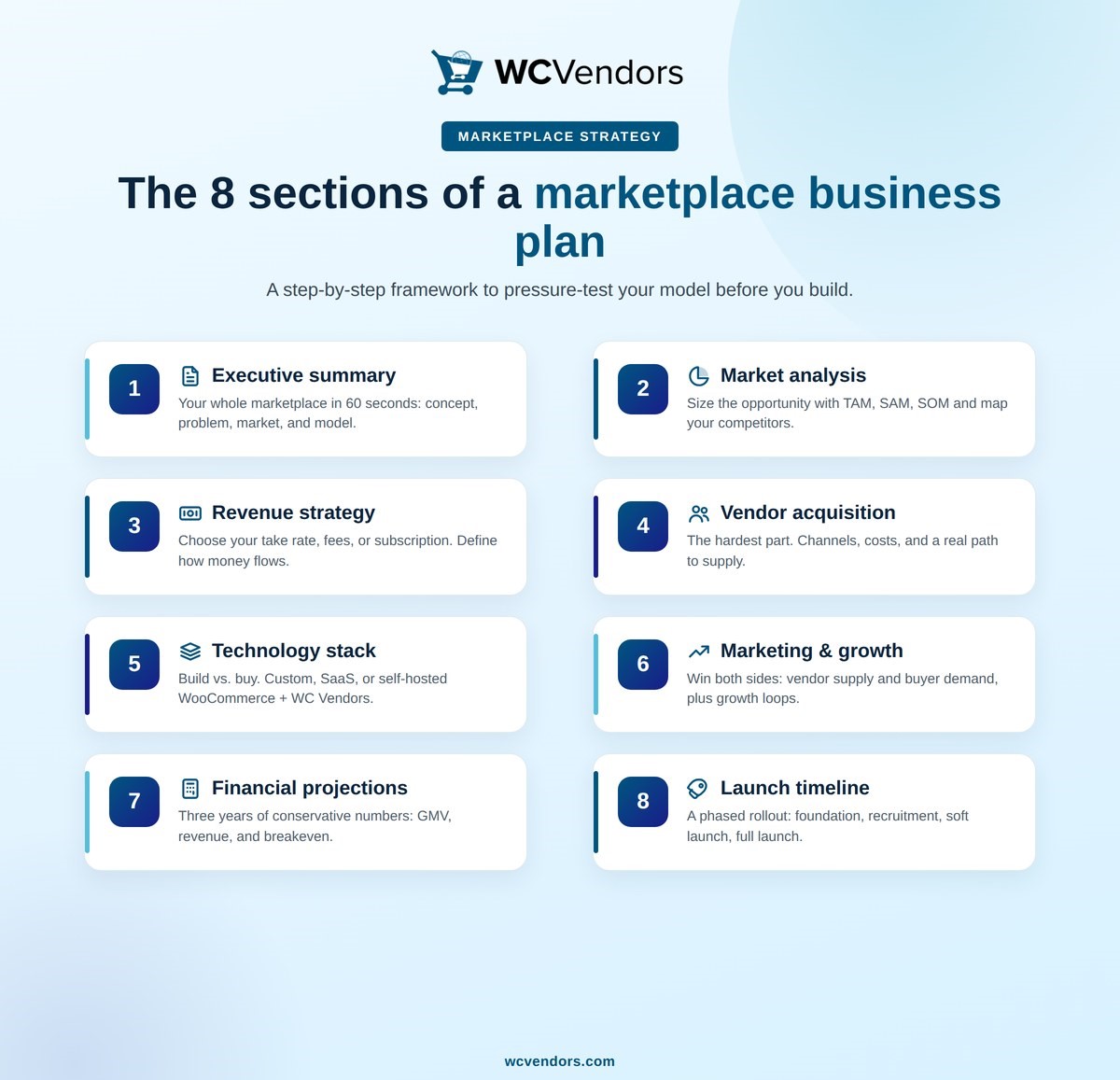
This guide walks you through eight sections of a marketplace business plan, complete with fill-in prompts and an illustrative financial model. It goes significantly deeper than the five-element overview we published earlier, giving you a complete framework you can adapt to your own niche.
Why You Need A Marketplace Business Plan
A marketplace business plan isn’t just for investors. Most marketplace founders bootstrap or self-fund, and they are the ones who benefit most from writing the plan. The document forces you to think clearly before you commit cash.
Writing a marketplace business plan pushes you to do the following:
- Define your marketplace’s value proposition in one sentence
- Identify your target vendors and calculate whether enough of them exist
- Model the economics and confirm the numbers work before spending money
- Build a realistic vendor acquisition strategy, not just “recruit vendors”
- Choose the right technology platform based on cost and capability, not hype
- Set milestones so you know whether you are on track or need to pivot
What we’ve seen: The marketplace business plans that succeed aren’t the longest. They are the ones that can answer a single question clearly: why would a vendor choose your platform over selling directly or on an established marketplace? If your plan can’t answer that in one sentence, go back to the drawing board.
Section 1: Executive Summary
The executive summary is a one-page overview of your entire marketplace business plan. Write it last, but place it first in the document. An investor or partner should understand your marketplace in 60 seconds.
A strong summary includes your marketplace name and concept in one sentence, the problem you solve, your target market and its size, your revenue model (commission, listing fees, subscriptions, or a combination), your competitive advantage, your key milestones at 6, 12, and 24 months, and your funding needs if you have any.
Fill-in prompt: “[Marketplace Name] is a [niche/category] marketplace that connects [vendor type] with [buyer type]. We solve [specific problem] by providing [unique value]. Our revenue model is [commission type/percentage]. In Year 1, we aim to reach [vendor count] vendors and [GMV target] in monthly GMV.”
Section 2: Market Analysis And Opportunity
This section proves that a meaningful market exists for your marketplace. The cleanest way to size it is the TAM, SAM, SOM framework.
TAM (total addressable market) is the total revenue opportunity if every potential customer used your marketplace. SAM (serviceable addressable market) is the portion you can realistically reach with your current model, narrowed by geography, category, or demographics. SOM (serviceable obtainable market) is the slice of SAM you can capture within your first 1 to 3 years, given your resources.
For a handmade goods marketplace, the numbers might look like this. The TAM is the global handmade goods market, valued at roughly $718 billion according to Allied Market Research. The SAM is US-based online handmade goods, estimated at $4 to $5 billion. The SOM is a Year 1 target of $500K to $1M in GMV from 50 to 100 vendors in one product category.
Next, map the competitive landscape. Identify three to five direct competitors and three to five indirect competitors, such as social media platforms, vendor-owned websites, and established platforms like Etsy and Amazon. For each, note their strengths, weaknesses, and your differentiation. Then articulate the market gap. Common marketplace gaps include excessive fees, lack of curation, poor vendor tools, a lack of community, or a lack of focus on a specific niche.
Section 3: Marketplace Model And Revenue Strategy
This is the financial engine of your marketplace business plan. Define exactly how money flows through your platform, then commit to a model.
Most marketplaces use commission, also called a take rate, which is a percentage of each sale and typically runs 10% to 25% depending on category. Listing fees charge vendors per product listed and are well-suited to high-volume catalogs. Subscriptions or memberships charge a recurring fee for vendor access and provide predictable revenue. Featured placement charges vendors for premium visibility. A hybrid model combines two or more of these, such as a base commission plus optional featured listings.
Fill-in prompt: “Our primary revenue model is [commission/subscription/hybrid] at [rate/price]. A typical vendor selling [average monthly volume] generates [monthly commission] in marketplace revenue. Secondary revenue from [listing fees/featured placement/premium tiers] adds approximately [percentage] to primary commission revenue.”
When you build your model on WooCommerce, WC Vendors supports a full range of commission types: percentage, fixed, percentage plus fee, fixed plus fee, and tiered structures based on vendor sales, product sales, or product price. These map directly to the revenue models above, and you can set them at the product, vendor, category, or global level. To turn a recurring fee model into reality, the WooCommerce monthly fee guide walks through vendor membership tiers and recurring billing.
Section 4: Vendor Acquisition Plan
This is the section most plans get wrong. They write “recruit vendors” as a single line item instead of a full strategy with channels, costs, and targets. Your vendor acquisition plan deserves the same depth as your product plan.
Start by understanding your supply. Figure out where your target vendors currently sell, whether that’s Etsy, Amazon, social media, craft fairs, or their own websites. Identify what frustrates them, usually fees, lack of control, or audience limitations. Then sharpen your pitch around lower fees, a niche audience, better tools, or genuine ownership.
From there, choose your acquisition channels. Direct outreach to vendors on existing platforms is high-effort but high-converting. Content marketing attracts vendors through search. Social media lets you engage the communities where vendors already gather. Referral incentives turn existing vendors into recruiters. Niche events such as trade shows and maker markets put you face-to-face with suppliers.
Fill-in prompt: “In Phase 1 (pre-launch), we will recruit [target number] vendors through [primary channel]. Our vendor value proposition is: [one sentence]. Estimated vendor CAC through [channel] is $[amount]. Monthly vendor acquisition target after launch: [number].”
What we’ve seen: When we review marketplace business plans, the weakest section is almost always vendor acquisition. Everyone details the technology stack and reduces vendor recruitment to a single bullet point. That’s the hardest part of the business, so your acquisition plan should be as detailed as your product plan.
Once vendors say yes, a smooth intake keeps them active. Our vendor onboarding process guide covers the welcome, account setup, verification, and first-listing steps, and a custom registration form removes friction at the very first step.
Section 5: Technology Stack And Platform Choice
This section covers the infrastructure that powers your marketplace. The key decision is build versus buy, and you have three realistic paths.
Custom development means building from scratch. You get full control, but it carries the highest cost ($50,000 to $500,000 or more) and the longest timeline (6 to 18 months). A SaaS marketplace platform like Sharetribe or Arcadier launches fastest, though it locks you into ongoing subscription fees ($200 to $2,000 or more per month) and limited customization. A self-hosted stack of WordPress, WooCommerce, and WC Vendors is the middle ground, offering full ownership, low cost, and flexible customization with only basic WordPress knowledge required.
The cost gap is dramatic. Custom builds run $50,000 to $ 500,000 or more up front. SaaS platforms run $2,400 to $24,000-plus per year in subscription fees plus transaction fees. A self-hosted WooCommerce and WC Vendors setup runs roughly $100 to $300 per year for plugins plus $200 to $600 per year for hosting.
For most marketplace startups, the self-hosted approach delivers the best balance of cost, flexibility, and speed. You can launch a functional marketplace in days, not months. WC Vendors handles the core marketplace layer (vendor registration, storefronts, commissions, and payouts, with Stripe Connect for automatic split payments included in the Pro plan), and the wider WooCommerce ecosystem supplies extensions for nearly every additional feature. For a full breakdown, see our guide on the cost of running a WooCommerce marketplace.
Fill-in prompt: “Our marketplace will be built on [platform]. Estimated platform costs in Year 1: $[amount]. We chose this approach because [rationale]. Key technology features required: [list: payment splitting, vendor dashboard, product management, etc.].”
Section 6: Marketing And Growth Strategy
Your marketing plan has to serve both sides of the marketplace: vendor acquisition on the supply side and buyer acquisition on the demand side. Treating them as one budget line is a common mistake.
On the supply side, lean on content marketing that targets vendor pain points, SEO for terms your vendors search such as “Etsy alternatives,” direct outreach to vendors on existing platforms, and a referral program. On the demand side, focus on SEO for product and category terms, a social presence where your buyers spend time, small and scalable paid acquisition, and email marketing to repeat buyers.
The real advantage comes from growth loops that connect both sides. Each new vendor brings their own audience. Each satisfied buyer tells others. Reviews and ratings build trust signals that attract more buyers, and more buyers in turn attract more vendor applications. A healthy marketplace business plan shows how these loops reinforce one another over time.
Fill-in prompt: “Our primary vendor acquisition channel is [channel], with a target CAC of $[amount]. Our primary buyer acquisition channel is [channel]. We expect organic growth (word of mouth, vendor-driven traffic) to contribute [percentage] of buyer traffic by Month [X].”
Section 7: Financial Projections
Financial projections for a marketplace business plan should cover three years and lean on conservative assumptions. Label everything as illustrative if you are working from estimates rather than real data. The model below shows what a niche marketplace might look like across its first three years.
Year 1 (Launch and growth)
50 active vendors by year end, averaging 12 products each, reaching $30,000 in monthly GMV by Month 12 and $180,000 in annual GMV. At a 12% take rate, that produces $21,600 in annual marketplace revenue. Payment processing runs about $5,220 (2.9% of GMV), platform costs $1,000, and marketing $6,000, for total costs of $12,220 and a Year 1 profit of $9,380.
Year 2 (Scaling)
150 active vendors by year end, $90,000 in monthly GMV by Month 24, and $720,000 in annual GMV. A 14% take rate (raised once value is proven) yields $100,800 in revenue. Against $38,000 in total costs, including part-time help, that leaves a Year 2 profit of $62,800.
Year 3 (Established)
350 active vendors by year-end, $200,000 in monthly GMV by Month 36, and $1.8M in annual GMV. A 15% take rate produces $270,000 in revenue. With total costs of $95,000 for team, marketing, and infrastructure, the Year 3 profit reaches $175,000.
The model assumes 10% monthly vendor churn in Year 1, declining to 5% by Year 3; average vendor monthly sales of $600 in Year 1, growing to $700 in Year 3; a marketing budget of $500 per month in Year 1 that scales with revenue; and no external funding. These are illustrative figures. Your actual numbers will depend on your niche, vendor quality, marketing effectiveness, and take rate, so treat this as a template structure and replace it with your own assumptions.
Section 8: Launch Timeline
A phased launch reduces risk and builds momentum. Spreading the work across four phases keeps you from opening to buyers before your vendor supply and purchase flow are ready.
1. Foundation (Months 1 to 2)
Finalize your business plan and revenue model, set up WooCommerce and WC Vendors on hosting, configure marketplace settings, build your branding, and create vendor onboarding materials.
2. Vendor recruitment (Months 2 to 4)
Begin direct outreach, recruit and onboard 15 to 25 committed vendors, help them create quality listings, test the full purchase flow including commission splits and payouts, and refine the vendor experience from feedback.
3. Soft launch (Months 4 to 5)
Open to buyers with limited marketing, monitor transactions for issues, gather buyer feedback on catalog, navigation, and checkout, and fix friction points before scaling.
4. Full launch (Month 6)
Increase marketing spend, announce publicly, begin buyer-focused SEO content, set up analytics dashboards, and start your vendor referral program.
Start Building Your Marketplace
A marketplace business plan is a tool for thinking, not a formality. The hours you spend working through these eight sections will save you months of trial and error, because the plan surfaces the hard questions while they are still cheap to answer. The market analysis tells you whether enough vendors exist. The revenue strategy confirms the numbers work. The vendor acquisition plan proves you have a realistic path to supply, which is the part almost every founder underestimates.
Once your plan is solid, the execution path is refreshingly straightforward. Set up WordPress, install WooCommerce and WC Vendors, configure your commission structure, and start recruiting vendors. The technology takes days to stand up. The planning is what takes weeks, and a well-built marketplace business plan is worth every hour you put into it.
Here’s what we covered in this article:
- Why you need a marketplace business plan
- Executive summary
- Market analysis and opportunity
- Marketplace model and revenue strategy
- Vendor acquisition plan
- Technology stack and platform choice
- Marketing and growth strategy
- Financial projections
- Launch timeline
Frequently Asked Questions
How long should a marketplace business plan be?
Keep it to 10 to 15 pages. Investors and partners won’t read a 50-page document. Cover the eight sections thoroughly, but keep each to one or two pages, and use bullet points, tables, and fill-in formats to stay scannable.
Do I need financial projections if I’m bootstrapping?
Yes. Even without raising money, projections force you to answer critical questions: what take rate covers your costs, how many vendors you need for breakeven, and how much to spend on marketing. Conservative projections keep you accountable.
What’s the biggest mistake in marketplace business plans?
Underestimating vendor acquisition difficulty. Most plans spend five pages on technology and one paragraph on getting vendors. Flip that. The technology is the easy part. Recruiting 50 quality vendors who create listings and stay active is the hard part.
Should I include funding requirements if I’m self-funding?
Include a budget section regardless of funding source. A clear budget that allocates money to platform costs, marketing, and a cash reserve prevents the common pattern of running out of marketing funds after overspending on platform customization.
How often should I update my business plan?
Review and update quarterly in Year 1. Your initial assumptions will be wrong in ways you can’t predict. After your first three months, update your vendor CAC, buyer CAC, average vendor revenue, and projections with real data. A plan that never evolves becomes fiction.