
This is the part most auction advice misses. Auction sniping gets written about as a tactic for bidders, complete with tools and browser extensions. From where you sit, running the marketplace, it is something else entirely: a closing rule that quietly costs you the bidders who lose to it.
Anti-sniping is the fix, and it is a setting rather than a policy. This guide covers how auction sniping affects your final prices and repeat bidders, how a soft close changes the incentive, and how to decide on the one number that matters when you turn it on.
What Auction Sniping Looks Like From The Seller’s Side
Auction sniping is a bid placed in the last seconds of an auction, timed so nobody can respond before the clock runs out. Researchers studying it settle on a three-second definition, which tells you how narrow the window is.
For the bidder doing it, the logic is sound. Bidding early signals interest, inviting someone to outbid them. A last-minute bid wins at whatever price the auction reaches, with no chance for a rival to react.
For you, the same behavior reads differently. Your lot closed. Somebody paid. Nothing looks wrong, which is exactly why the problem persists across so many marketplaces: it produces no errors, no complaints, and no refund requests. It produces a slightly lower closing price and a bidder who does not return, and neither shows up in a report.
How common it is depends on what you sell. In the eBay data behind the study below, over a third of cell phone auctions were won in the final second, and over half were sniped within the last sixty seconds. Thinner markets, where a lot has only a handful of interested bidders, see more of it than busy categories.
Late bidding also has nothing to do with whether bids are visible. It is a property of the clock, not of the format. If you run sealed bid auctions where amounts remain hidden, a fixed end time still rewards the bidder who waits.
Why Last-Second Bidding Depresses Final Prices
A snipe wins at the current price plus one step, not at what the sniper was willing to pay. That gap is your lost revenue, and it is the whole argument for changing the closing rule.
Work through what a hard deadline teaches an experienced bidder. Bidding early drives up the price and warns rivals, while waiting costs nothing and risks only losing to another late bidder. So the rational move is to hold back, which means the price sits still for days and then jumps once, seconds before the close. The lot never finds out what the second-highest bidder would have paid.
The damage to your bidder base is larger than the damage to any single lot. According to Backus, Blake, Masterov, and Tadelis (2015), bidders who were sniped were about 18 percentage points less likely to return to bid, compared with bidders who lost without being sniped. For context, that comparison group already failed to return 49 percent of the time.
Read that as an operator and it stops being an academic finding. Every sniped auction is a small win on price and a real risk of losing a registered bidder, and bidders are the expensive thing to acquire. Sellers notice the closing price. You are the one who notices the shrinking pool of people bidding.
There is a related trap worth naming. Operators who see lots closing low often raise starting prices, which further suppresses early bidding and makes the situation worse. If you want a floor under a valuable lot, a reserve price does that without discouraging the bidders you want.
Extend-On-Bid: How A Soft Close Fixes It
Extend-on-bid pushes the closing time out whenever a bid lands inside a set window before the end. Instead of ending at a fixed moment, the auction ends when bidding genuinely stops.
The change in incentive is immediate, and it is the entire point. A late bid no longer denies anyone a response, because the act of bidding creates the time for one. Waiting stops being a winning strategy, so bidders go back to doing what you want: bidding what the item is worth to them when they decide it is worth it.
Here’s how the two closing rules compare:
| Closing rule | What bidders do | Effect on final price | Effect on disputes |
|---|---|---|---|
| Hard close at fixed time | Wait, then snipe | Often depressed | Underbidder complaints |
| Extend on bid (soft close) | Bid when they value it | Closer to true value | Fewer |
Choosing the extend window
The window is the only setting that needs judgment, and the trade-off runs in both directions. Too short and a bidder on a slow connection or a phone still cannot respond in time, so you have kept the problem and added a setting. Too long and popular lots drift for hours past their advertised end, which frustrates the winner and makes scheduling collection awkward.
A few minutes suits most marketplaces. Match it to how long it realistically takes one of your bidders to notice they have been outbid and place another bid, including the time for the notification to reach them. If your bidders are mostly on mobile and rely on email alerts, err on the longer side.
One thing we commonly see: operators turn on a soft close, set the window to thirty seconds because it sounds responsive, and conclude the feature does not work. Thirty seconds is not enough time for an email to arrive, be read, and be acted on. The setting was fine. The window was too short to let a human being do anything with it.
Tell your bidders the rule exists. An auction that visibly extends looks broken to someone who does not know it is meant to, and you will field the question every time otherwise. One line on the listing is enough.
When a hard close is the right call
A hard close is not always wrong. If you run a high volume of lot closings on a schedule, predictable end times are operationally simpler, and extending closes makes batch fulfillment harder to plan. Bulk lots with many near-identical items also see less auction sniping, because a bidder who loses one can bid on the next.
The case for a soft close gets stronger the more distinctive and valuable the lot, and the more you care about the bidder coming back.
Proxy Bidding As The Other Half Of The Answer
Proxy bidding lets a bidder enter the most they will pay, then bids on their behalf in increments only as far as needed to stay in front. It solves the other half of the problem: bidders who cannot be present at the close.
The two settings work on different failure modes. A soft close protects the bidder who is paying attention but gets beaten on timing. Proxy bidding protects the bidder who is asleep, at work, or in a different time zone from your closing schedule. Run both and being present at the end stops mattering at all, which is the state you want.

Before the setup section, it is worth clarifying what provides this, because the naming is confusing. We do not ship a standalone auction engine. Auction functionality comes from WooCommerce Simple Auctions, a separate plugin. What WC Vendors Simple Auctions adds is the integration that makes those auctions work with WC Vendors Pro, so your sellers run their own lots from their own dashboard instead of everything passing through you.
So the stack is three parts: WooCommerce, WooCommerce Simple Auctions for the auction mechanics, and WC Vendors Pro with our integration for the multi-seller layer. Both extend-on-bid and proxy bidding are supported, and since version 1.2.5 in June 2026, vendors can configure extend-on-bid themselves from the vendor dashboard rather than asking an administrator. That last part matters: when only an administrator can change a closing rule, it gets set once and never revisited, because every change is a support request.
Configuring Anti-Sniping on Your Marketplace
Turning anti-sniping on is a small job, and the order matters more than the individual steps. Get the stack in place first, then set the rule, then test it before any real lot depends on it.
In broad terms:
- Install WooCommerce Simple Auctions alongside WC Vendors Pro, and configure the integration to connect them.
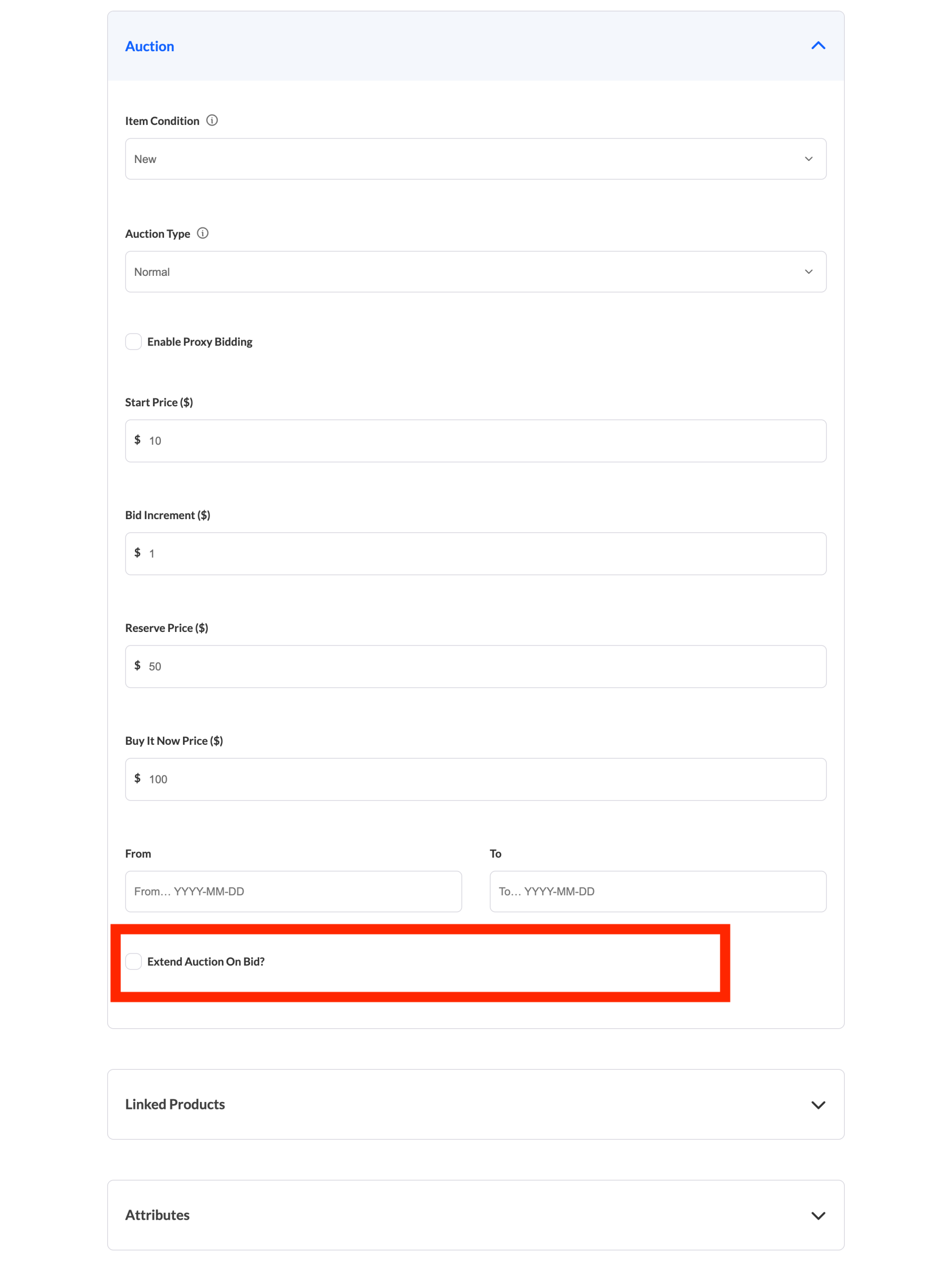
- Enable extend-on-bid and set your window, then enable proxy bidding.
- Decide whether sellers may override the per-lot window or set a marketplace-wide default.
- Add a line to your listing template explaining that late bids extend the auction.
- Run a test lot end-to-end and snipe it yourself from a second account.
Do not skip the last step. Bid from another account in another browser inside your extend window, and watch what the clock does. When I first set a soft close up, I found the behavior was correct, and my own notification email took long enough to arrive that a short window would have been useless, which is the sort of thing you only learn by trying to beat your own auction.
For the full click-by-click walkthrough, our knowledge base covers how to enable extended auction on bid on the vendor dashboard. If you are still putting the pieces together and want the bigger picture first, our guide to building an auction website covers the infrastructure around the auction itself.
Set Your Closing Rule Before Your Next Auction Opens
The takeaway is that a closing rule is not an administrative detail. It is the incentive your bidders respond to, and a fixed end time quietly teaches them all to wait. Anti-sniping does not stop anyone from bidding late. It just stops late bidding from being the way to win.
Most operators discover this after many close badly. It is cheaper to change the setting first.
Here’s what we covered in this article:
- What auction sniping looks like from the seller’s side
- Why last-second bidding depresses final prices
- Extend-on-bid: how a soft close fixes it
- Proxy bidding as the other half of the answer
- Configuring anti sniping on your marketplace
If your sellers run their own auctions and you want them to tune their own closing rules, see what WC Vendors Simple Auctions adds on top of WooCommerce Simple Auctions and WC Vendors Pro.
Frequently Asked Questions
What is auction sniping in an online auction?
Auction sniping is a late bid placed in the final moments of an auction, timed so no other bidder can respond before the clock runs out. Anti sniping is the fix: a closing rule, usually called extend-on-bid or a soft close, that pushes the end time out when a bid arrives late, so the auction ends when bidding stops rather than when the clock originally said it would.
Does anti sniping actually raise final prices?
It removes the incentive to wait, which is what holds prices down on a hard close. Bidders who know a late bid will be considered tend to bid their true valuation rather than hoping to slip in at the end. Published research on eBay found bidders who were sniped were substantially less likely to bid again, so the retention effect matters alongside any price effect.
How long should the extend window be?
Long enough for a bidder to receive a notification and respond, which for most marketplaces means a few minutes rather than seconds. Very short windows are the most common reason operators think the feature is not working, because no human can act inside them.
Is proxy bidding the same as anti sniping?
No, they solve different problems and work well together. Proxy bidding lets someone set their maximum in advance so they do not need to be present. Anti sniping changes when the auction ends so that being present stops conferring an advantage.
Can my sellers control this themselves?
Yes. Extend-on-bid can be configured from the vendor dashboard, so sellers adjust the closing rule on their own lots without going through an administrator. This tends to produce better-tuned settings, since sellers know their own categories.
Should every auction use a soft close?
Not necessarily. High-volume, near-identical lots see less auction sniping and benefit from predictable end times, so a hard close is reasonable there. Distinctive or high-value lots, where losing an underbidder is expensive, are where a soft close earns its keep.